Art in America Magazine February 2018 Amelie Van Wolffen Artists
Ciara Phillips | Jean-Ulrick Désert

Palimpsest – Reading between the signs
Ciara Phillips | Jean-Ulrick Désert
Exhibition: November 27, 2021 – January thirty, 2022
Opening: Friday Nov 26, 2021, 7-11 p.m.
Finissage: Sunday, January 30, 2022 from 3-six p.k.
Viewing by date merely: ina@subsequently-the-butcher.de or mobile: +49(0)178-3298106
Social distancing measures must be observed in the gallery spaces and wearing a medical mask is compulsory.
The exhibition Palimpsest / Reading Between the Signs develops a visual dialogue between the works of Berlin-based Haitian-American creative person Jean-Ulrick Désert and Glasgow-based Irish gaelic-Canadian artist Ciara Phillips.
Jean-Ulrick Désert takes upwardly in his work, developed for this exhibition, a political action at the Berlin Wall from 1978 past the filmmaker Wieland Speck (1992-2017 Managing director of the Panorama of the Berlin Film Festival) and the artist Per Lüke, which immediately triggered a surveillance investigation file called "The Harpist" (Der Harfenspieler) by the GDR's State Security Police. For his installation Désert selected 12 sheets from the Stasi files, digitized them and burned them in linen to create 'modern ruins'. The data from this Stasi surveillance and Désert's research generated 4 astrological circular terracotta forms. They mark the star constellations and the astrological configurations taken from the 13 Baronial 1978, xvi:xv, the day of the political action. Another deejay marks the life span of the surveillance and all the same some other disk marks the collaborative dynamics of Per Lüke & Wieland Speck. Together with the moving-picture show panels they create a poetic palimpsest and a tension betwixt personal and public, counterpart and digital or physical and metaphysical realities.
For this exhibition, Ciara Phillips foregrounds clothing equally a site of social appointment and pregnant. Sewing has long been an artistic practice for Phillips, realized in parallel with her graphic print work. Printed textiles are often part of her complex spatial installations. Phillips explores the myriad ways in which impress intersects with our daily lives, whether through media, advertising, banknotes, or clothing. Everywhere, print products act every bit important validators and signifiers. Phillips spent four weeks in residency at Lichtenberg Studios developing new works for this exhibition which draws on, amid other things, the centuries- old history of textile and clothing manufacturing in Lichtenberg.
article well-nigh the exhibition at artlink


Ciara Phillips works mainly in print and her arroyo is both expansive and experimental. She often works collaboratively, transforming galleries into working printshops and inviting other artists, designers and local customs groups to work with her. She has exhibited at: Tate Uk; Museum of Contemporary Fine art Australia; Benaki Museum, Athens; Hamburg Kunstverein; and Kunsthall Stavanger. In 2014 she was nominated for the Turner Prize, and in 2020 was awarded the Queen Sonja Print Award in Oslo.
Jean-Ulrick Désert works in dissimilar media: posters, actions, paintings, site-specific sculptures and video. In 2019 Jean-Ulrick Désert represented his native country Haiti at the 58th Venice Biennale in the aforementioned yr he showed Unfinished Histories Vol.Four, at the Franziskanerkirche Monastery Ruins, Berlin. In 2013, Amour Colère Folie, Art Commission, Martinique Biennale, Martinique; 2015 Belgian Soliloquy, Platform 102, Brussels; Jean-Ulrick Désert, Espace d'art Contemporain 14°N 61°Due west, Martinique; 2018 Jean-Ulrick Désert, S12 Studio, Select World Project Gallery, New York. He was a participant in the tenth Havana Biennial, Republic of cuba, in 2009. Désert founded his Berlin studio in 2002. www.jeanulrickdesert.com
Jean-Ulrick Désert is the offset recipient of the Wi Di Mimba Wi :: AKB & SAVVY Contemporary Award: www.e-flux.com
Bernadette Van-Huy | Herman Asselberghs
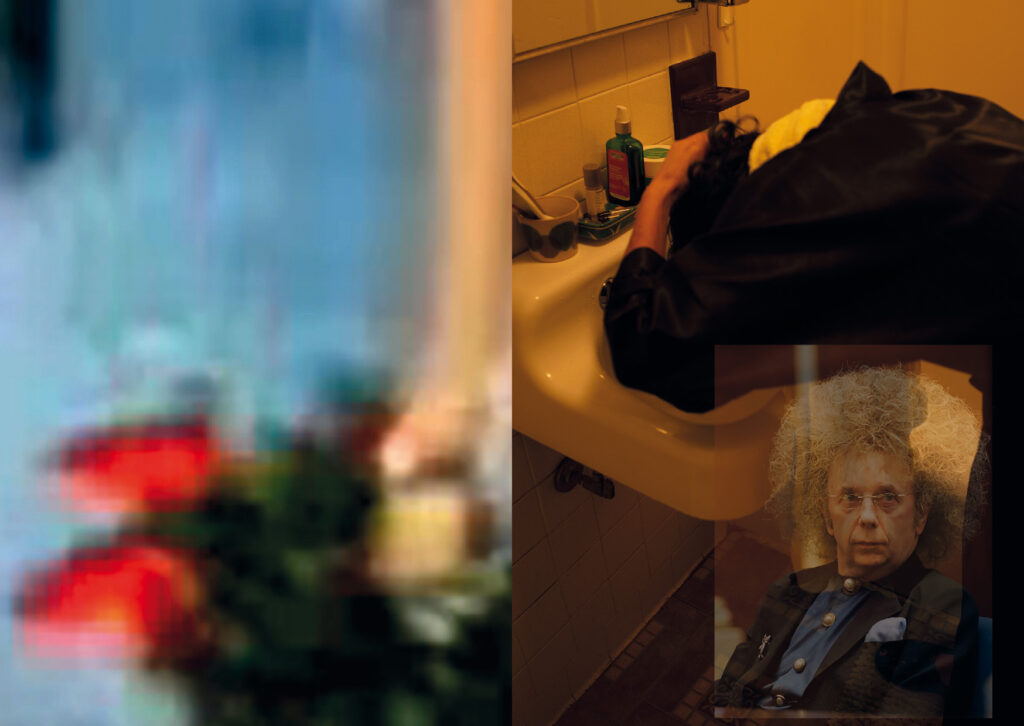
The Few, The Many Exhibition: sixteen. Oct – 14. November 2021
Opening: Fri xv. October 2021, from 7 p.m. on
Finissage: Dominicus November 14, from iii-7 p.m.
With its upcoming exhibition The Few, The Many, afterward the butcher is delighted to present two contemporary creative perspectives from New York and Brussels. For the exhibition at after the butcher, New York-based creative person Bernadette Van-Huy produced a new twelve-role photographic drawing series titled Turn the Mirror Upside Down. The self-portraits, accompanied past a wall text in the course of a mirror-written instruction for action, are about an outlaw, a volume, outer space, an Asian, and a homemade perm.
At the invitation ofafter the butcher Belgian film artist Herman Asselberghs fabricated Now (After Empire Remix) (video, color, 16:nine, English, BE, 2021, 18'), a remix version of his video After Empire from 2010. InAfter Empire ,Herman Asselberghs suggested an culling for the iconic paradigm that collective memory has kept as the quintessential moment of recent history: the worldwide anti-war demonstration on the 15th of February 2003 instead of two towers collapsing on the isle of Manhattan. Today, a decade, a celebration of nine/11 and many marches all over the world later on, the filmmaker presents a remix version by providing part of the initial images with a new, contemporary soundtrack past Simon Halsberghe and Wiet Lengeler.
At the occasion of the exhibition, butchers blätter #3 will exist published next to the online format as well as a impress edition, with contributions by Dieter Lesage, Andreas Siekmann and Ina Wudtke.
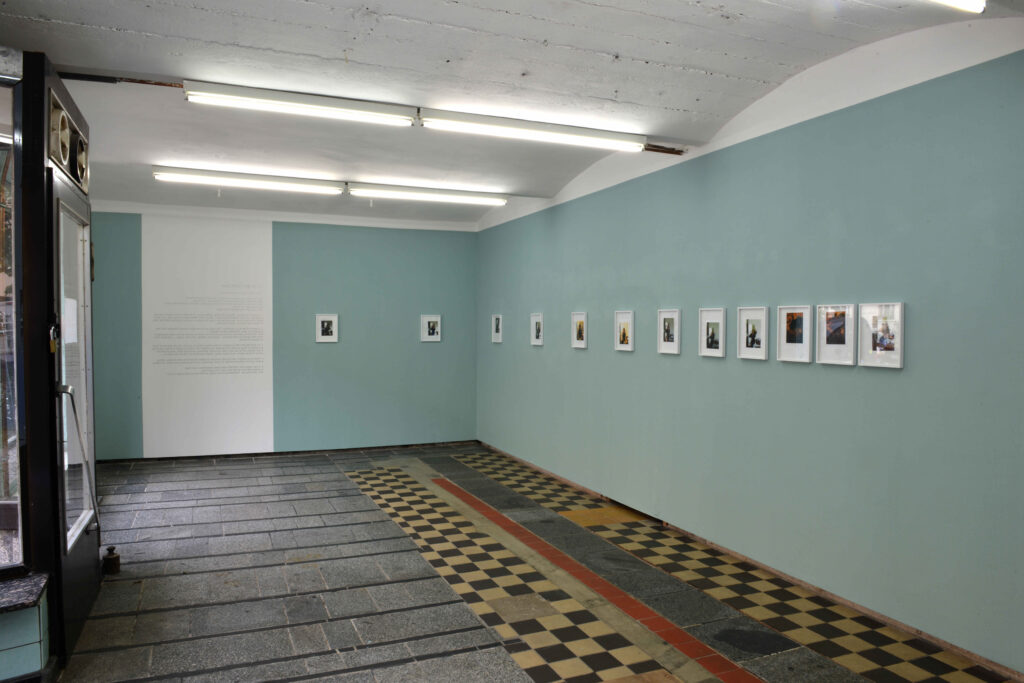
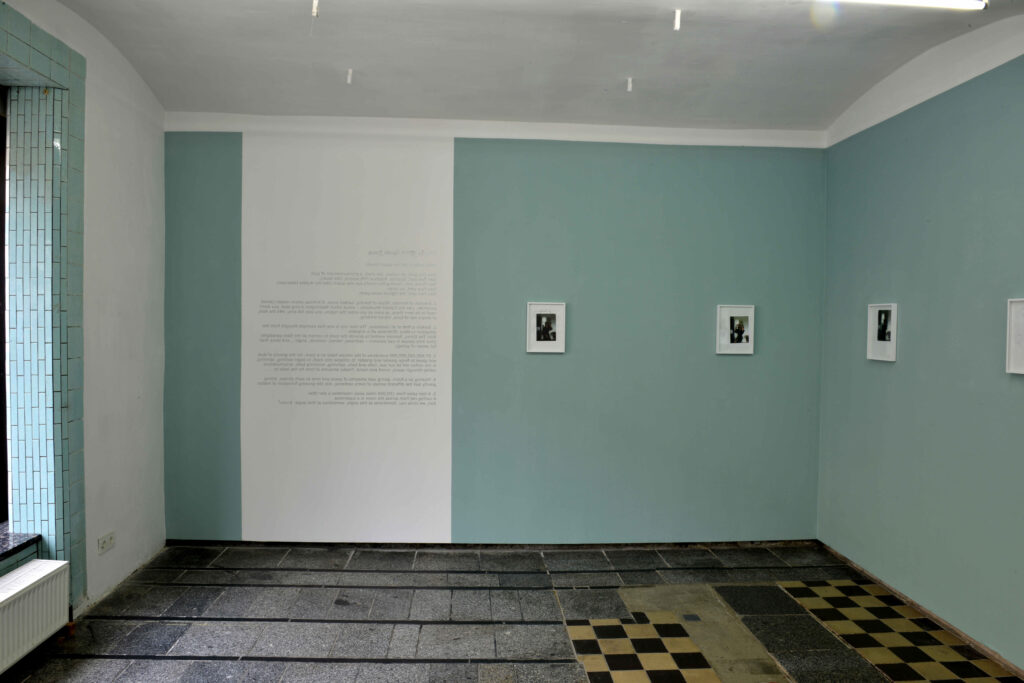
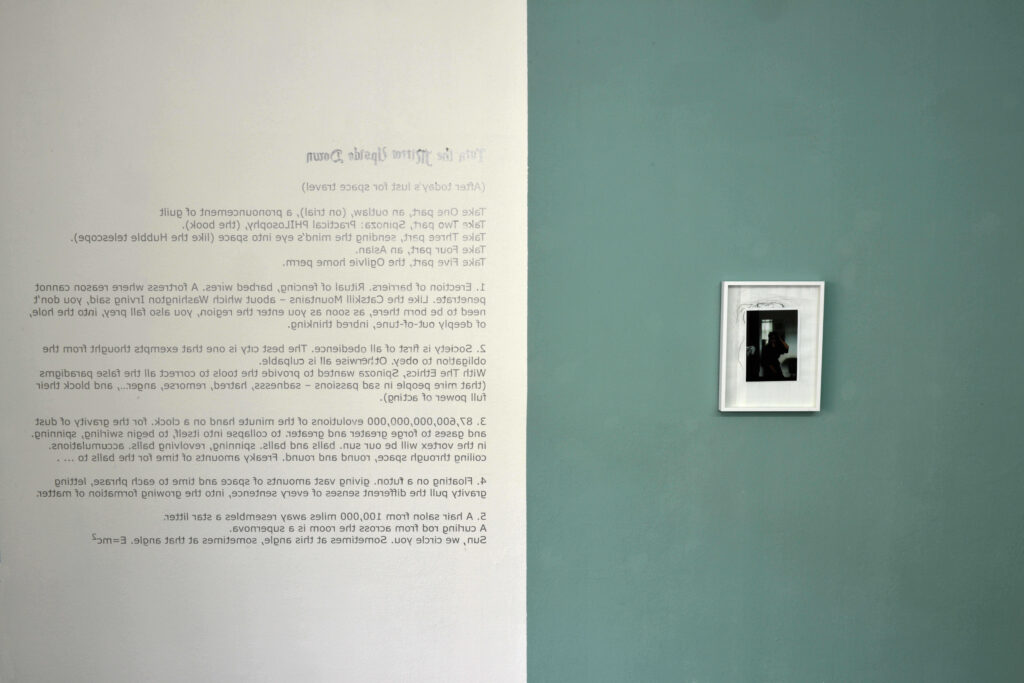
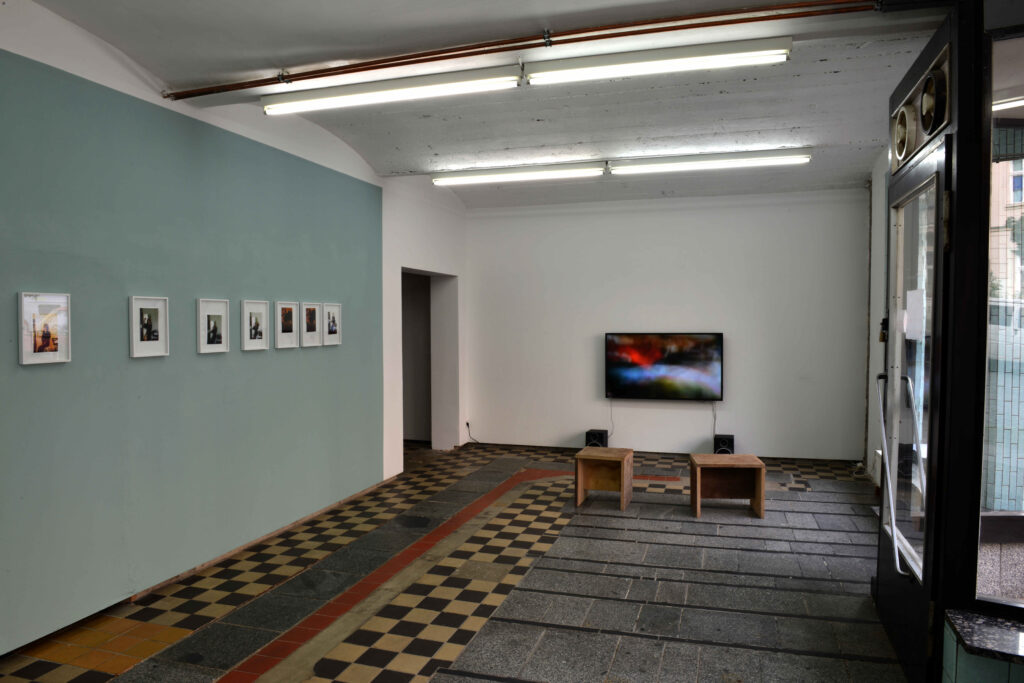
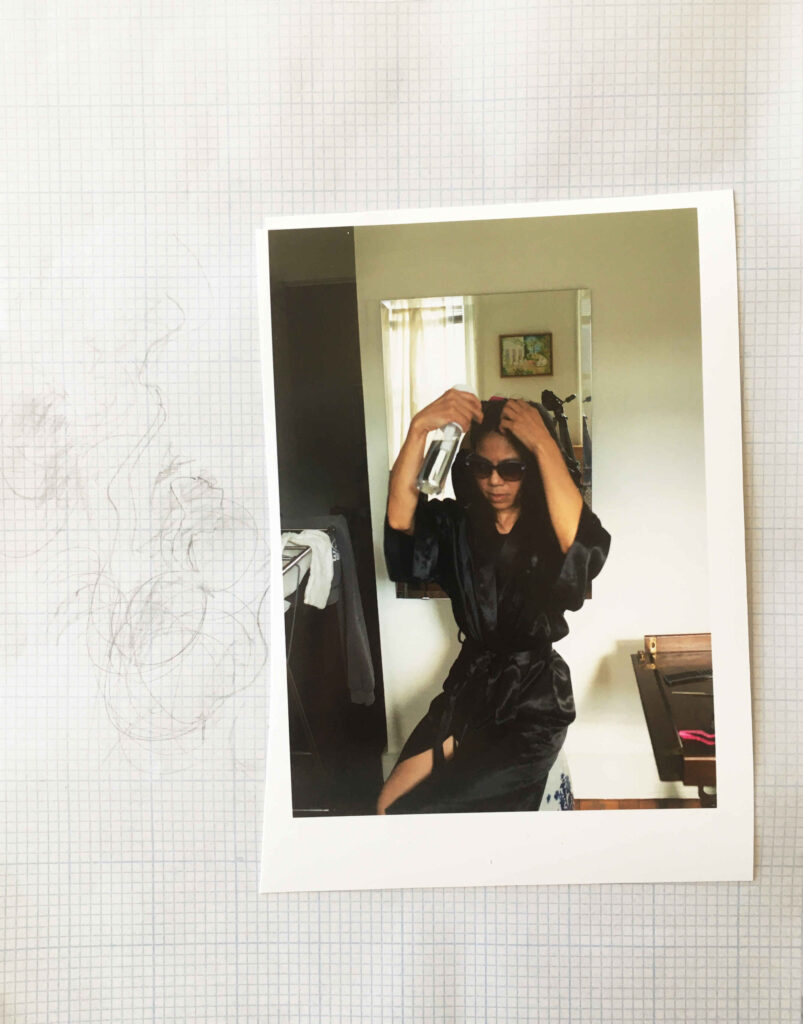
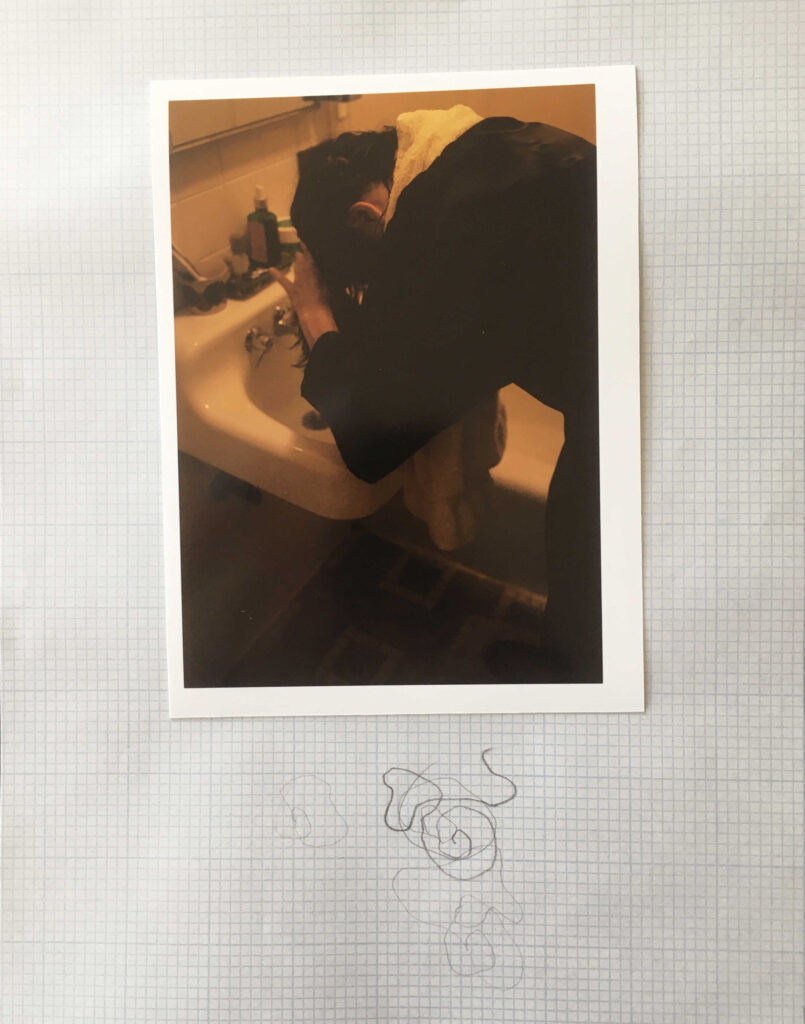
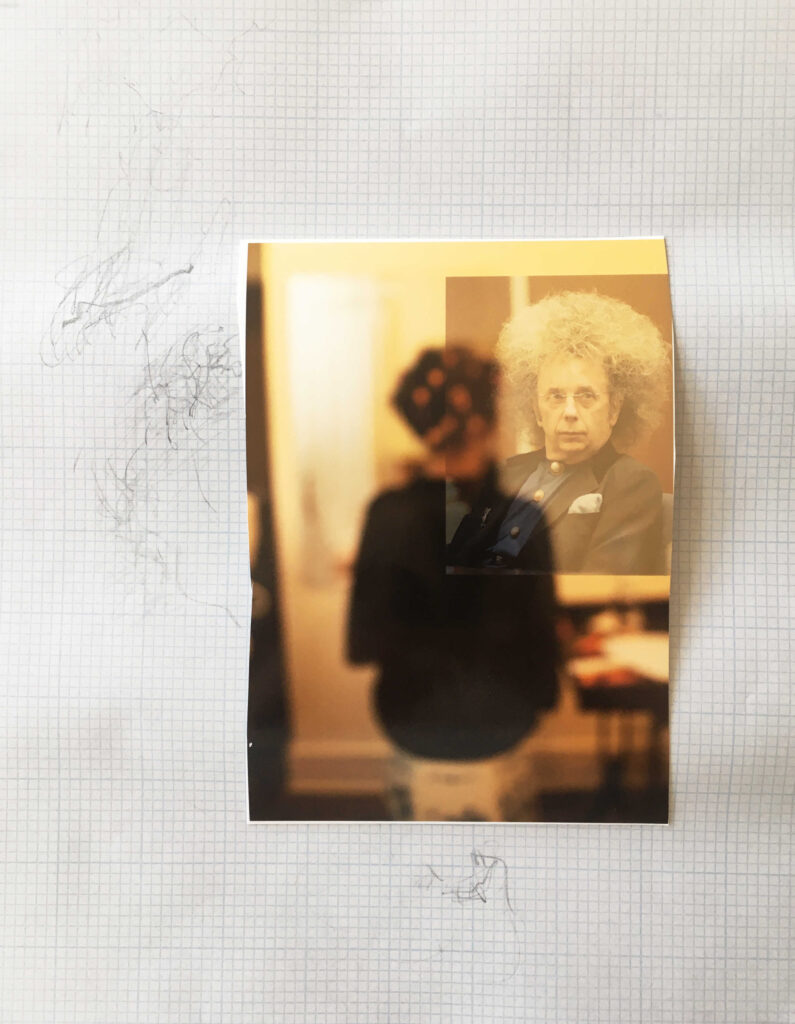
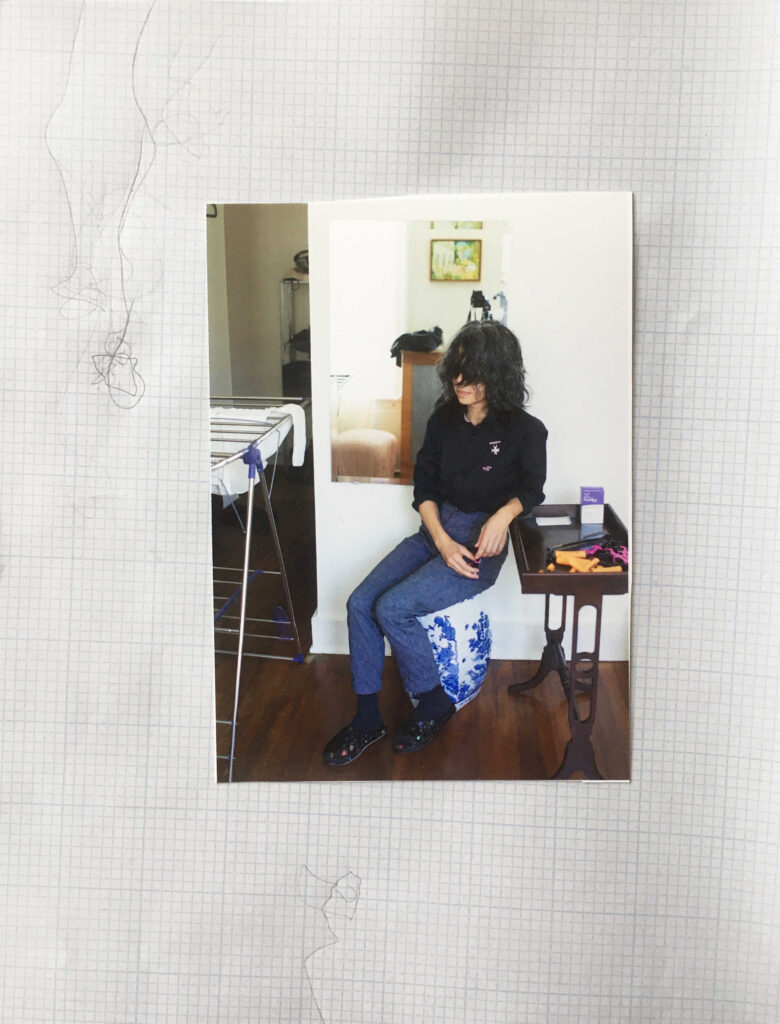
Bernadette Van-Huy is a founding member of Bernadette Corporation. She has also been working artistically under her own proper name for several years and exhibits internationally. She lives and works north of New York, USA.
Film artist Herman Asselberghs (°1962) explores border zones between text, sound and paradigm, world and media, poetics and politics. Over the past two decades, his film and installation works have been shown internationally. He teaches at the film section of LUCA School of Arts – Sint-Lukas Brussel and is a founding fellow member of the Brussels production platform Auguste Orts (augusteorts.be). He lives and works in Brussels, Belgium.
With the kind back up of:
Kaj Osteroth & Lydia Hamann | Xiaopeng Zhou
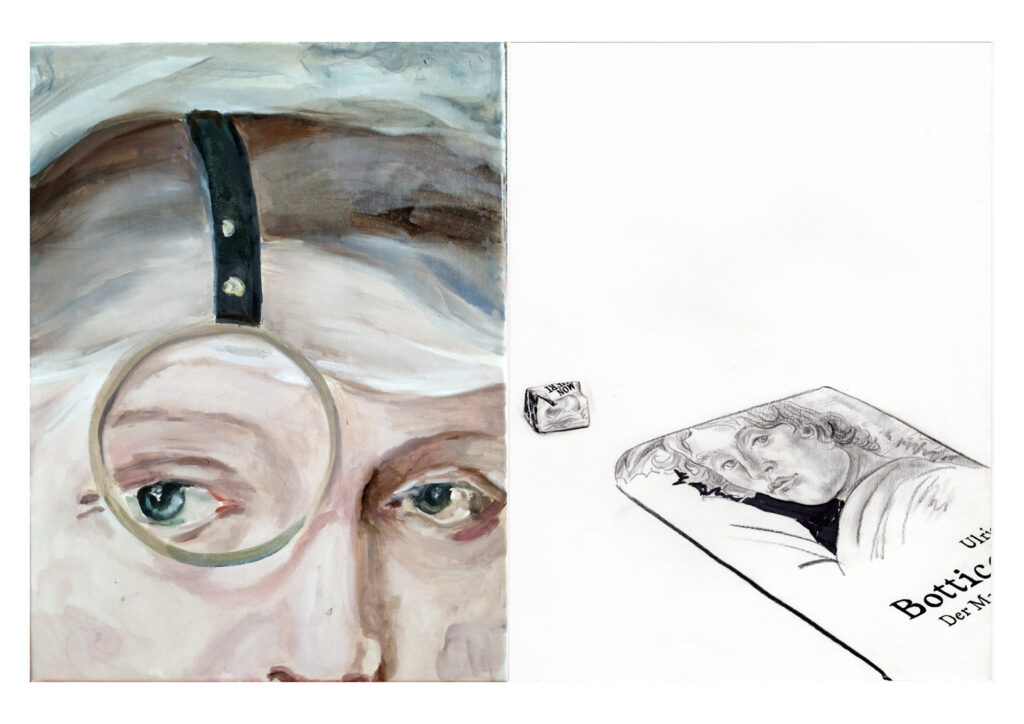
Good Copy – Bad Copy Exhibition: August 22, 2021 – October 3, 2021
after the butcher is delighted to present the forthcoming exhibition representing two artistic perspectives whose work not only addresses fundamental social questions but also explores copying through cartoon and painting equally an artistic method.
Lydia Hamann & Kaj Osteroth take worked together as an artist duo since 2007. They are currently working on their projection Glamshots. Malerinnen in der Berliner Gemäldegalerie (Glamshots. Women painters in the Gemäldegalerie, Berlin), with the relationship between the art works of female and male artists from the permanent collection of the Gemäldegalerie, Berlin. It is striking that out of 1000 paintings on display, only 6 are past women artists: Anna Therbusch, Marie Vigee-Lebrun, Angelika Kauffmann, Marie Latour, Anne Vallayer-Coster, Sofonisba Anguissola. The picture is no less problematic in the entire gallery holdings, where just xx of the 3500 pictures are by women artists. Lydia Hamann & Kaj Osteroth decipher the pictures by these women artists through a collaborative assay of moments, gestures and viewpoints. The results are a sampling of details from 20 different pictures from the collection on display and in storage. Hamann & Osteroth are big fans of repetition and imitation, copying the paintings of other women artists. They imitate, recreate, interpret, fail, are confronted with their own possibilities and methods, understand, admire and give up to the ecstasy of colour. In this style they move within a fascinating dialogue, in front of and with the originals. In conversion to canvas, they trust in their usual methods of incapacity, a cheerful copying, accompanied past disability and reluctance and the question of what makes a good copy or a bad re-create.
The Chinese artist Xiaopeng Zhou has taught cartoon to an elderly lady in Berlin for some fourth dimension. In the beginning he taught her to draw flowers, trees, cacti and other plants in the Botanical Garden and in turn, drew her while she drew the plants. In doing so, he used reportage drawing every bit an important method of his artistic enquiry. During the lockdowns, Zhou and the elderly lady met in her apartment to continue drawing and he learnt more virtually her interest in philosophy, literature, fine art history and feminism. The learning process became reciprocal and more intensive every bit Zhou improved his German language skills besides. At after the butcher, Zhou presents a video work documenting this joint learning and working process. He besides shows some of the drawings that were made in this context, drawings from the Botanical Garden and her apartment in which conversations happened about emotional and concrete piece of work, illness, therapy and healing and their ain unlike experiences of age, gender and civilisation.
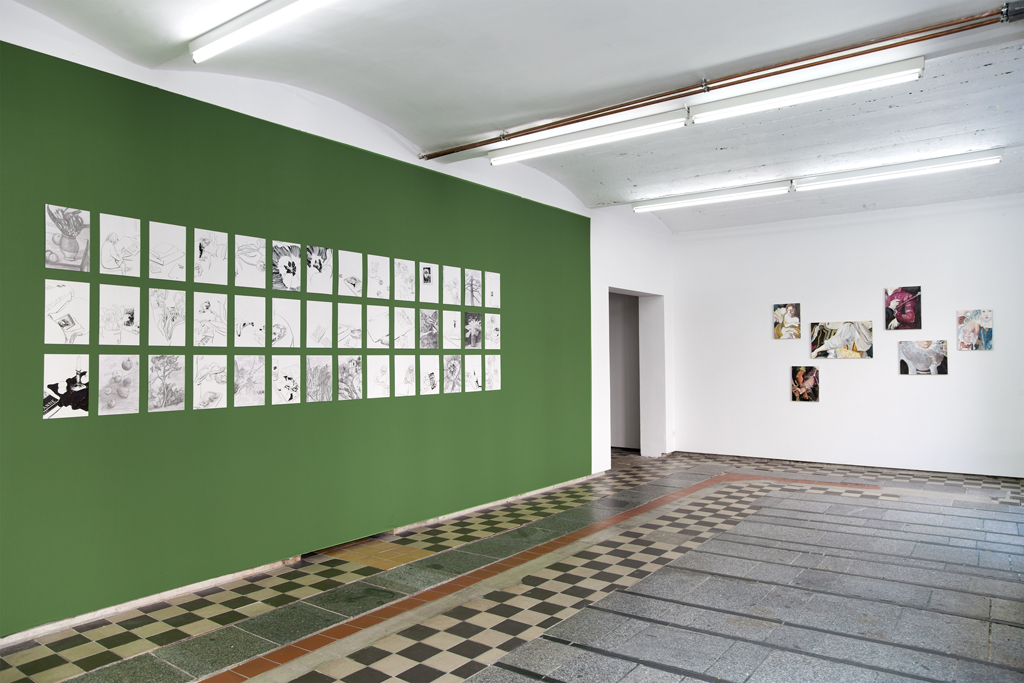
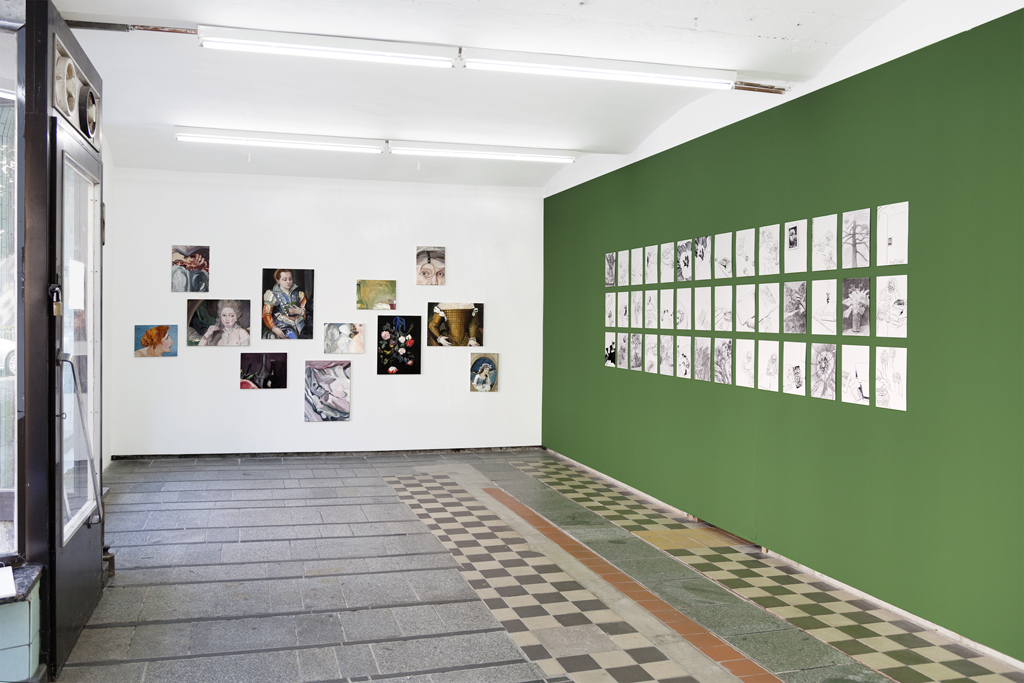
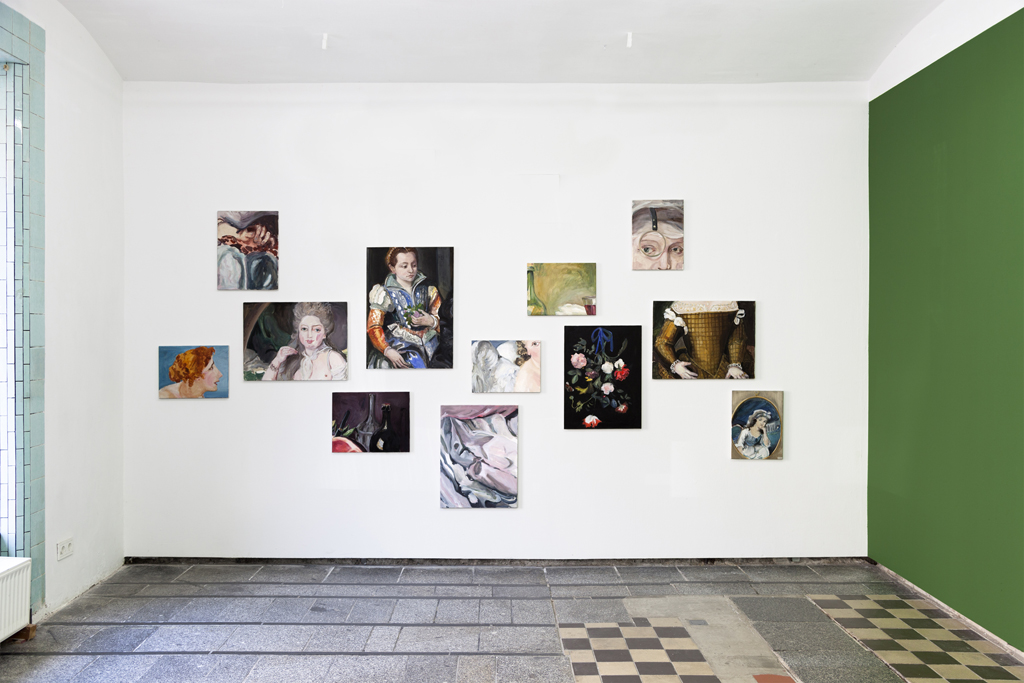
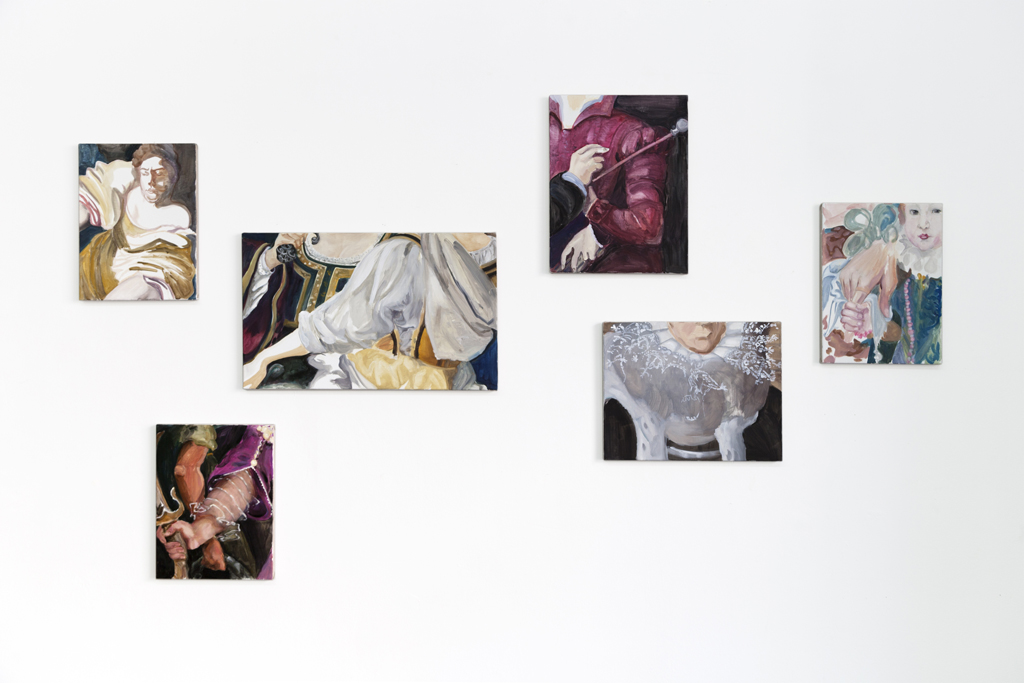
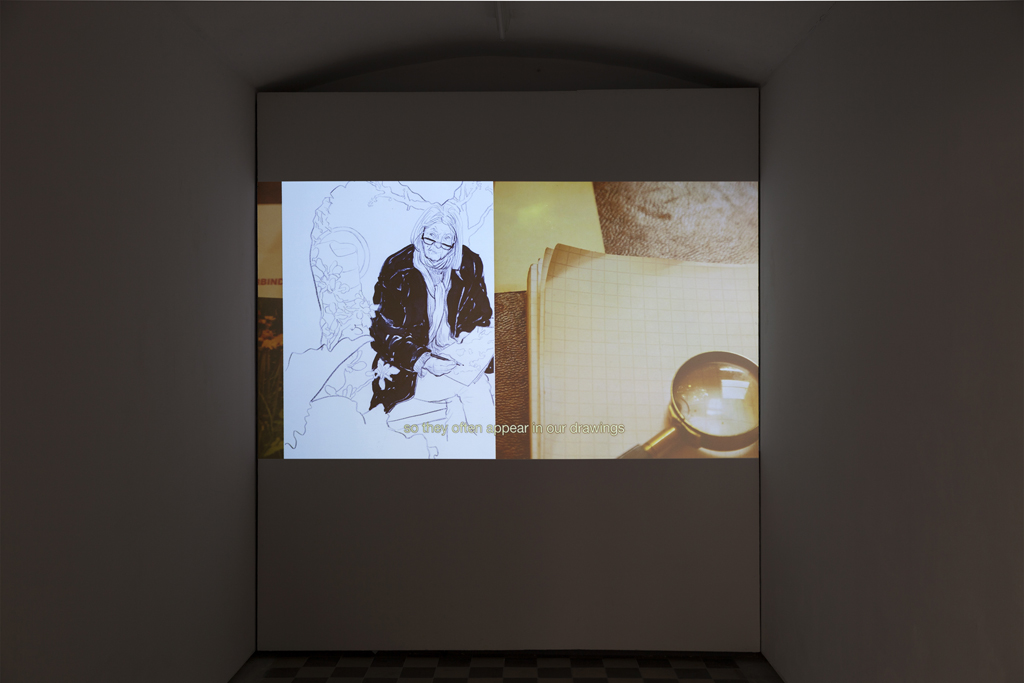
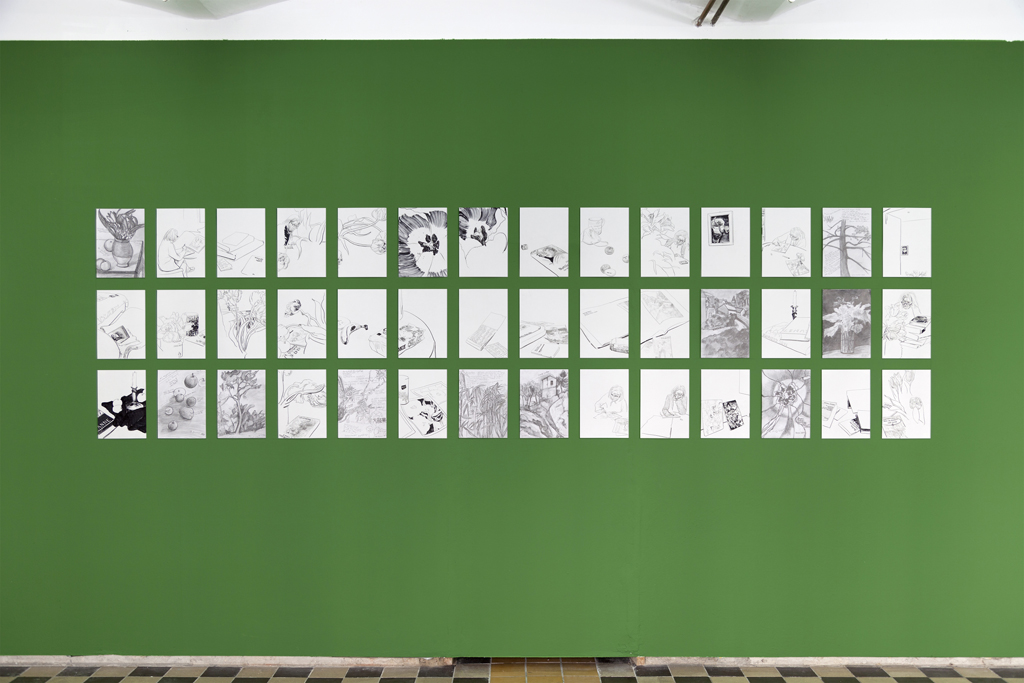
The duo Lydia Hamann & Kaj Osteroth question stereotypical attributions, dominant Eurocentric fictions and their ain experiences of the scope of collective practice. Kaj Osteroth studied Fine art History and Ethnology at the Freie Universität and Fine Art at the Academy of the Arts, Berlin. Lydia Hamann studied Art History and Cultural Studies at the Humboldt Academy and Fine Fine art at the Kunsthochschule Weissensee, Berlin. In 2020 they were awarded the Villa Romana Prize. They took function in the exhibition Histórias Feministas / Feminist Histories at MASP, São Paulo in 2019. In 2018 they published the book Racical Admiration and were part of the We don't need another hero Berlin Biennale. In 2017 they took part in The Future is Female person festival with a workshop at the Sophiensaele, Berlin. www.fleeingthearch.org
Xiaopeng Zhou studied at the Kunsthochschule Weissensee Berlin and at the Guangzhou University of Fine Arts. His nigh recent solo exhibitions are: Monochromatic Lottery Balls, Xining Contemporary, Xining, 2019 and Shape of Appetite, 2018, Empfangshalle München (in collaboration with Han Tang). Group exhibitions: BPA-Exhibition, 2021, KW Berlin; Interrupted Meals HOW Art Museum, Shanghai, 2020; An Impulse to Turn Inside-Out Art Museum, Beijing, 2020; Further Thoughts on Bawdy Materials Kunsthaus Hamburg, 2019 and Bi-Metropolis Biennale of Urbanism\Architecture, (UABB), Shenzhen, 2017. www.xiaopengzhou.com
Funded past:
Shannon Bool, Anton Bo Matzke, Kim Hankyul
Cracks and Reforms and Bursts in the Viopermit Air
Exhibition: June xviii – August 15, 2021
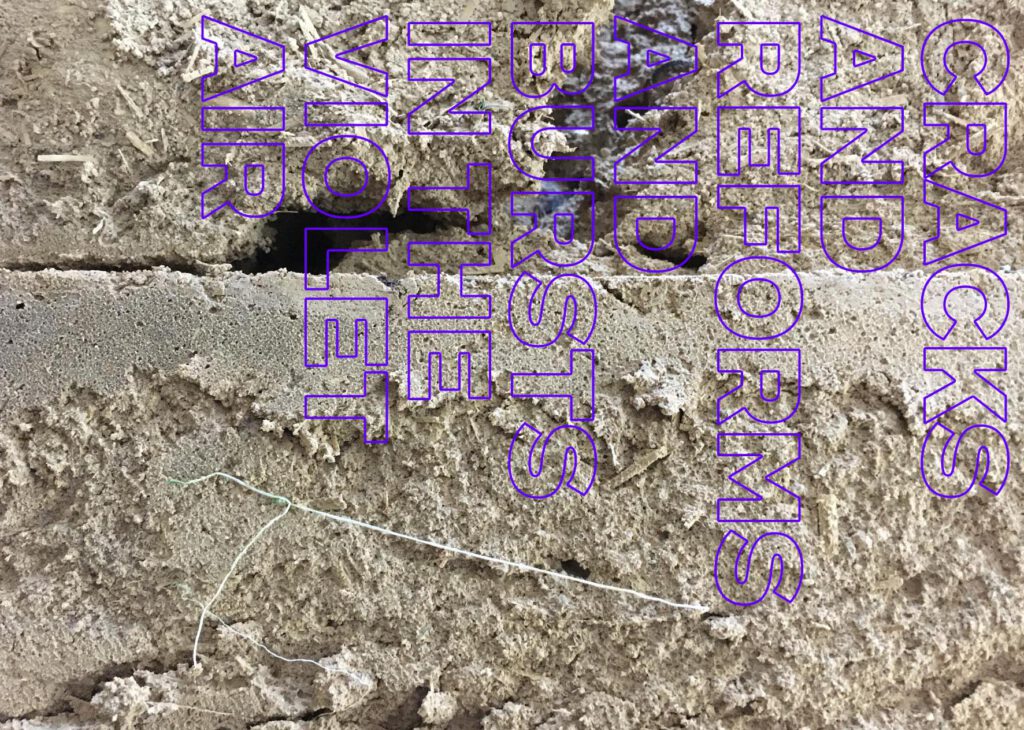
Cracks and Reforms and Bursts in the Violet Air presents a constellation of artworks by Shannon Bool, Kim Hankyul and Anton Bo Matzke that meditate on the status of artistic production inside broader fields of social relations. The championship of the exhibition borrows a line from T.S. Eliot's, The Waste Country (1922), an influential early modern verse form that makes use of numerous images and lines of text from other sources to describe a postal service-war landscape through affects, shifts in voice and fragmented narratives rather than through factual clarification. The innuendo is fitting, because the current sense of doubtfulness in the wake of the pandemic, too as an overall disillusionment with living for over xxx years under neo-liberalism and its social and economic failures. The artists accept used the situation to mount a serial of artworks that repurpose and redistribute ways of production and interrogating systems for valuing everyday life.
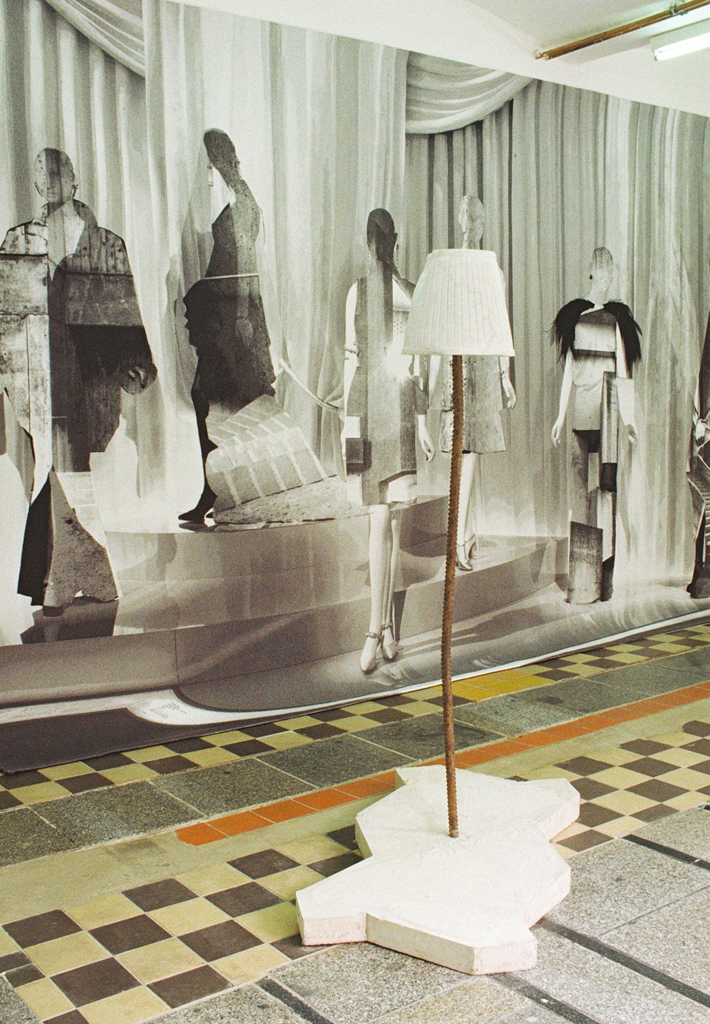
Shannon Bool'southward large-format tapestry, Crimes of the Futurity, appropriates a documentary photograph of an exhibit in the Yves Saint Laurent Museum in Paris. The work proposes a complete rethinking of the materiality of images through perforating and exploding the symbolic linguistic communication of photography every bit an artistic medium. The filigree of pixels that make up the digital image are technically translated into a Jacquard weaving – resolution gets fuzzy in the procedure. Mannequins are elided and replaced by collaged images of signature brutalist buildings, echoing the digital, systemic control of information. Alongside a 'digital' sensibility in the artwork is as well an 'analog' one: the representation of the female person body is revealed as a projection screen and naught of a consumerist gaze. Bool resurfaces the generic silhouettes to present specific, high-modern dwellings of religious civilization such as the Wotruba Church in Vienna by Fritz Wotruba, the Neviges Church building in Düsseldorf past Gottfried Böhm, or the Second Goetheanum in Dornach past Rudolf Steiner. The mod myth of the sacred value of legibility of purpose, achieved by a rest of design and pick of materials, is upended past Bool, revealing a whole hierarchy of hidden conservative values that are ultimately designed to manage desire as well as the movements and labour of human bodies.
Kim Hankyul'due south Serpent (2016) and Bird (2019) are ii of his before kinetic and sonic sculptures that repurpose ordinary tools and materials to serve as substrates for new significant. The works 'perform' absurd nevertheless everyday movements and tasks that are either excessive or underwhelming in the mimetic sense, further taking reward of the gap between sign and signified. Ophidian moves excessively, the consequence of the writhing and wild hissing of the ducting is manic and haunting – i is witness to an expenditure that begins from an electrical outlet and ends somewhere in the imagination. Bird features 2 pages of a volume held by an armature that is blithe by a drill that you can make out the gentle trounce of its wings. The volume – two of its pages – are transformed from a cerebral container of knowledge to an object of poetic reflection on the dream of flying. In this respect, the sculpture also tangentially evokes class associations: knowledge is power. This is the very central to their magic: the viewer is left to gauge the effect of the work, and yet is repetitively returned to the mechanical slavery of its performance. In my eyes, the kinetic sculptures pose critical questions in terms of working class labour and its relation to contemporary artistic product – is labour unsightly? Is it too sweaty? Does it strive also difficult for expression, for meaning? In this sense, the works are humorous and very effective in their easygoingness.
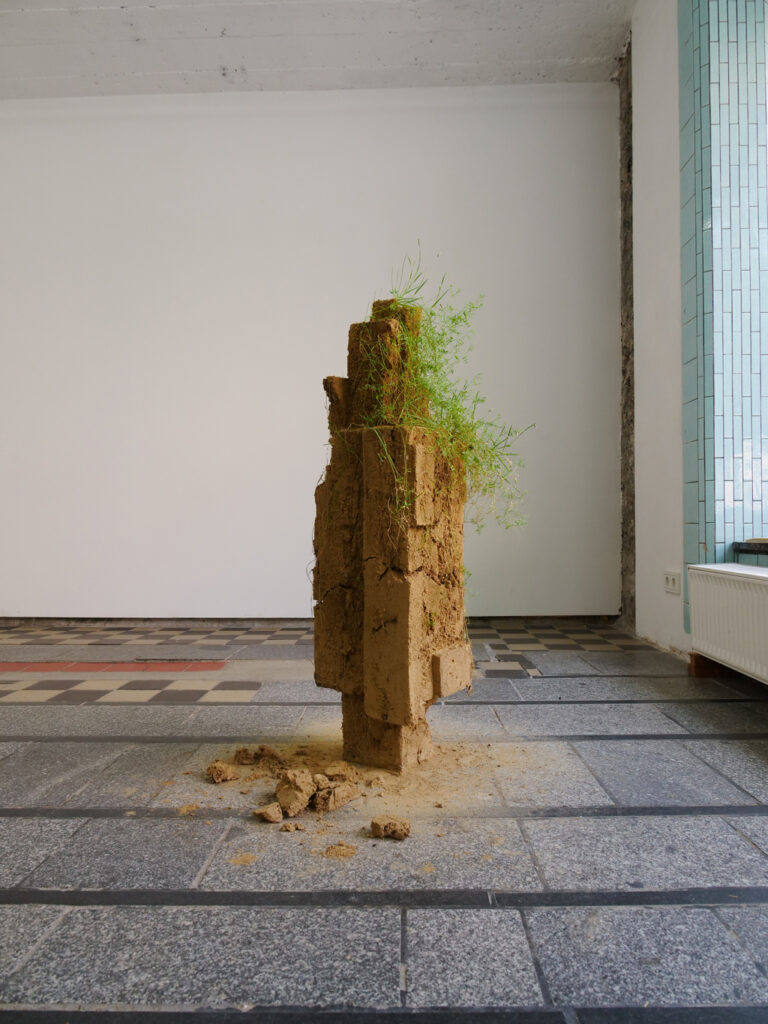
Anton Bo Matzke's Melde (2021) and Hom(e)age (to stonemason Ekhof Platz) (2018) are sculptures that symbolically and materially draw their qualities from the environment of the exhibition infinite; they seem to precipitate the site in which they are presented. They are tranquility objects that express the transitoriness of life in a manner akin to even so-life painting. Melde is a clay sculpture whose form evokes that of contemporary compages. The artist has planted ruderal seeds in the raw dirt which he collected from a vacant lot in the Victoriastadt, nearby later on the butcher. Over the course of the exhibition, the sculpture volition be blithe by the growth of vegetation, – it will have on a life of its own, so to speak; the seeds and their roots will slowly scissure open its course and possibly cause the form to plummet: work in progress. Hom(due east)age (to stonemason Ekhof Platz), is a sculpture in the form of a continuing floor lamp, whose base of poured physical and metre-long piece of rebar as well present construction materials often discarded in vacant building lots. The unusual element is a marble lamp shade atop the rebar that is old and crinkled- looking every bit though one would smell cigarette smoke on it. The overall sensibility of the works is one of improvisation with materials at hand, and what they address are issues apropos gentrification, class and urban renewal – for better or worse.
Text by Maxwell Stephens
We look forward to your visit.
funded by:
Grade OF ASTA GRÖTING

RANDOM ACCESS MEMORIES
Andreas Baumgartner, Laura Dechenaud, Jan-Louis Gens, Leonardo Grüning, Pauline Hömmen, Juhi Hong, Gregor Kieseritzky, Charlotte Kremberg, Luis Kürschner, Johannes Möller, Jeroen Laessig, Sophie Pape, Lucila Pacheco Dehne, Camilla Schiegnitz, Stefan Schramm, Julika Teubert, Simiao Yu, Yuan Yuan, Hye Yun
Exhibition: May 7-June 13, 2021
subsequently the butcher, exhibit for contemporary art and social issues is pleased to invite you to visit random access memories an exhibition with students from the form of Asta Gröting at the Braunschweig Academy of Fine Arts.
Exhibition: seven May – xiii June 2021
Opening hours: Fridays 5pm-10pm, Saturdays 12pm-8pm and Sundays 12pm-6pm. We kindly enquire you lot to register for the visit by mail:
ina@afterward-the-butcher.de or telephone call us on 0178-3298106 to get your personal time-slot.
Current rules to prevent the spread of C19 employ in the showrooms.
When we dream, we are in a place that seems to exist aslope our reality. A previously hidden conglomeration of unconscious impressions, fears and desires opens up to us. For the surrealists, the reality experienced during sleep was no less of import than the waking state. André Breton wrote in his Surrealist Manifesto of 1920:
"(…) why should I non concede to the dream what I sometimes deny to reality, namely that value of my own certainty which is not at all denied by me during the dream-span?".
At least this consequence directly experienced in the dream tin hardly be evaded by anyone. Despite this, or precisely because of it, nosotros often find information technology difficult to draw and comprehend the line between dream and reality. This is particularly noticeable in utopias and daydreams, which often speak of desires and ideals that do not seem accessible for us at all.
In the exhibition random admission memories, the Gröting class asks how reality tin can influence our dreams, or rather how dreams influence our reality.
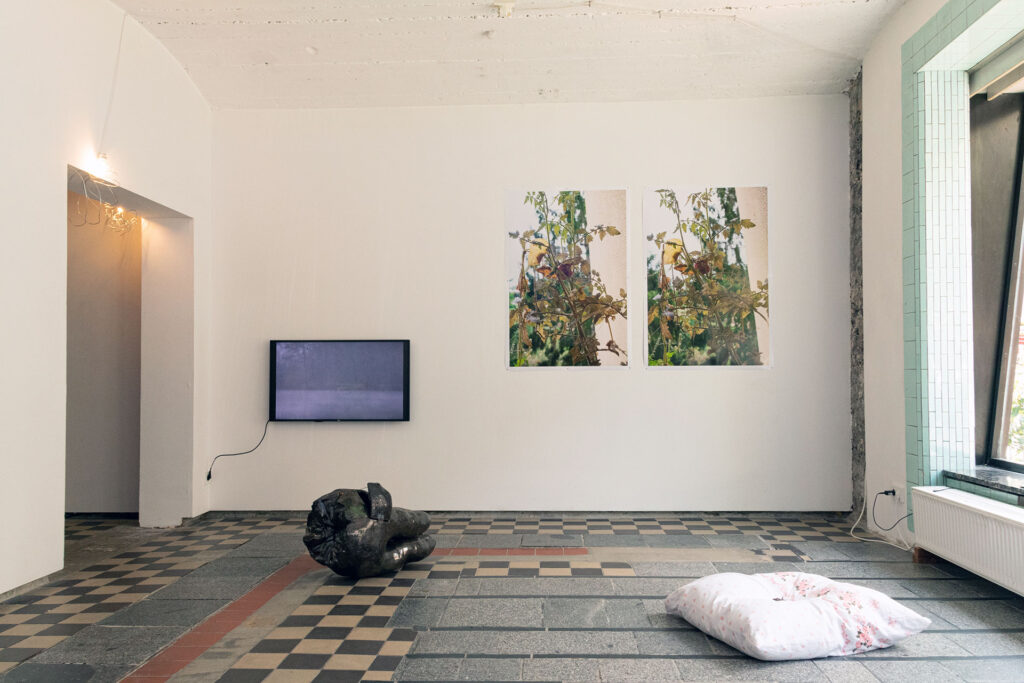
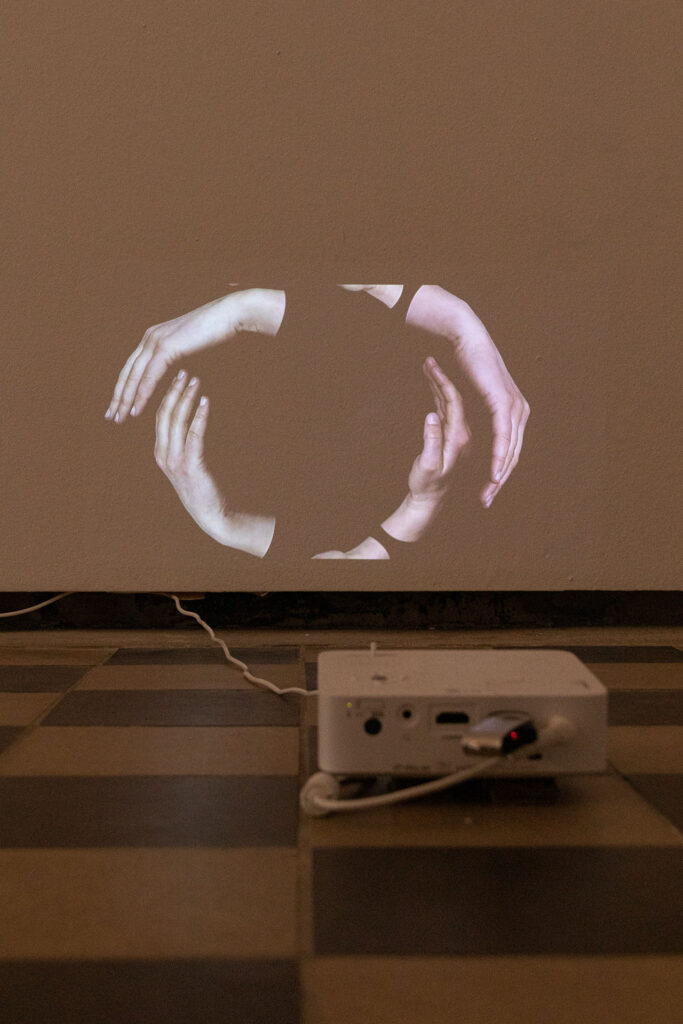
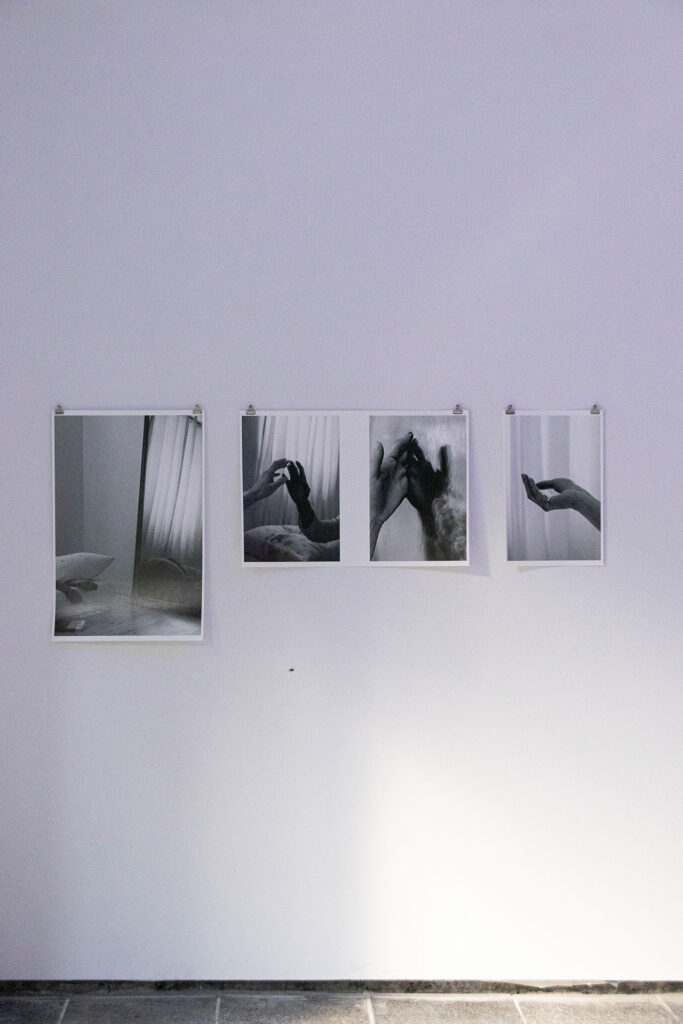
"We have really met every calendar week on Mondays since January to found a mutual process. Continuity was especially important because we couldn't meet in real life. We always try to shape and decide everything democratically and on a horizontal hierarchical level. This slows downwards the process, just it is important for our grade cohesion.
Nosotros practice this by looking at what topics interest and excite united states of america at the moment and connect us all in some mode. We decided on the topic of dreams because we run across it as a prissy option to connect the personal and the social.
To develop the concept together, we started doing dream experiments. We set ourselves a new task every week to see if nosotros can influence our dreams together. For instance, one week we all listened to the same vocal before going to bed to run into what would happen. Another week nosotros read an extract from André Breton's Manifesto of Surrealism, which is too virtually dreams, every bit the last action earlier going to sleep. We wrote down our daily routine and actively tried to control our daydreams. Through these experiments we got into conversation with each other about what dreaming ways and how we dream.
What was foreign near the process was that it is actually a very personal and individual topic, but the online conference naturally brought a certain distance into it. Sitting together and hatching together in our studio was sorely lacking! Only I still remember that the exhibition was only the right matter at this fourth dimension to work on something together again and to plan something more than physical and to get into conversation. I remember it was and still is very practiced and important for the course and its development process that there is this mutual "point" of the exhibition, the bringing together of the works. Maybe information technology will exist the cardinal when we look dorsum later on on this special, as well difficult period of the pandemic, that we tin still remember something beautiful that nosotros worked on and experienced together…" from the advice between students and Asta Gröting.
We await forward to your visit.
funded by:
Press release download
November 20, 2020 – March 7, 2021
artists: A-Clip, Gruppe Gummi K / MicroStudio Surplus (Alice Creischer, Martin Ebner, Christoph Keller, Ariane Müller, Andreas Siekmann, Nicolas Siepen, Josef Strau, Klaus Weber, Amelie von Wulffen), Jaaaa& Protzband Nicolas Siepen, Siegfried Koepf & Martin Ebner & Gunter Reski, Josef Kramhöller, NEID, Annette Wehrmann, Ina Wudtke, Amelie von Wulffen and others.
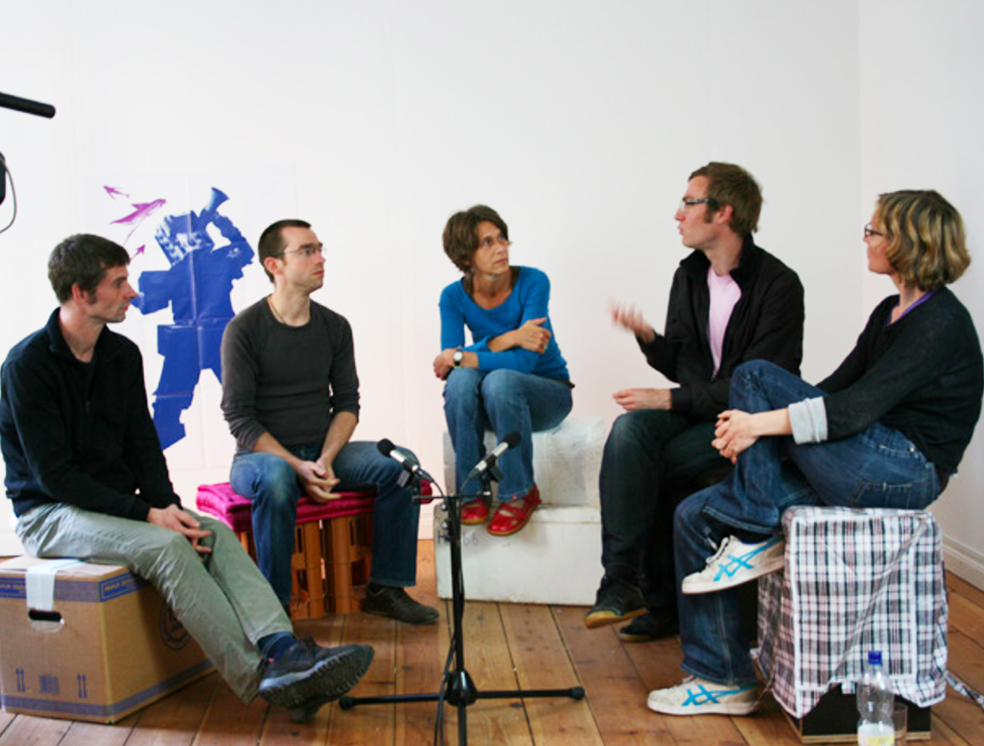
On Thursday February 18, 7 p.thousand. KW Institute for Contemporary Art, Berlin and after the butcher invite y'all to an Onlinetalk near the exhibition. Speakers are: Annette Maechtel, Thomas Kilpper, Ina Wudtke and Kathrin Bentele.
Exhibition: November 20, 2020 – March 7, 2021. Due to the current lockdown and until further notice, the exhibition can just be visited online: videowalk through the exhibition.
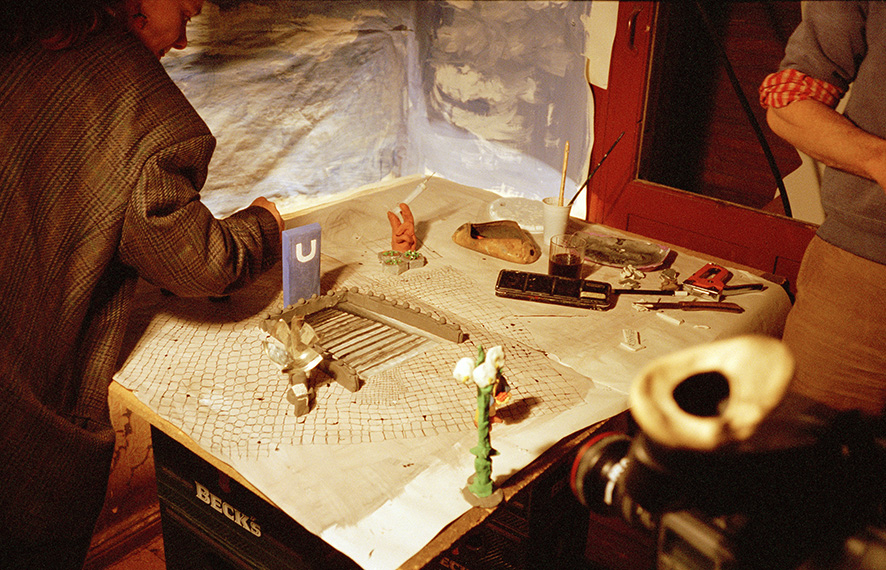
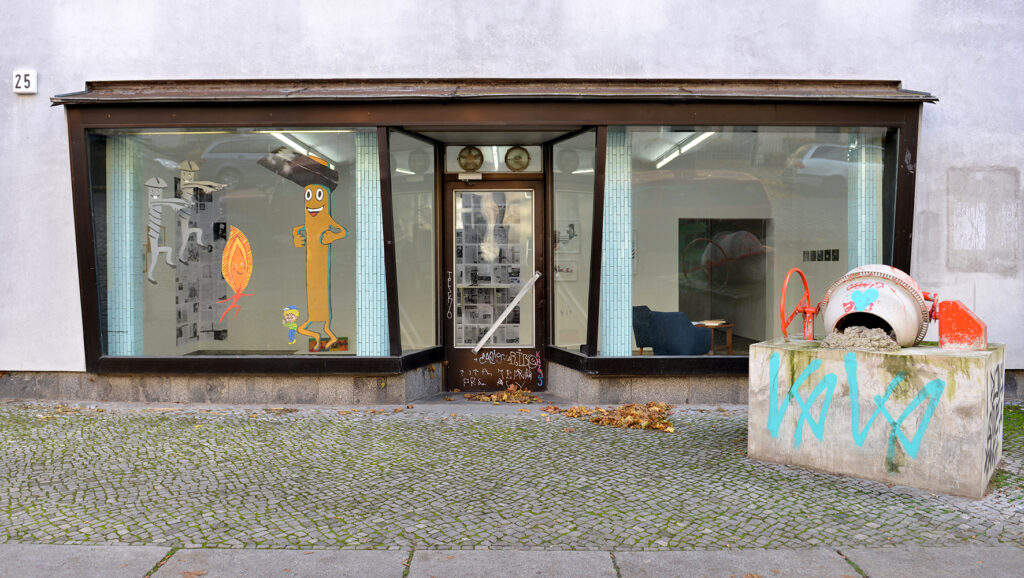
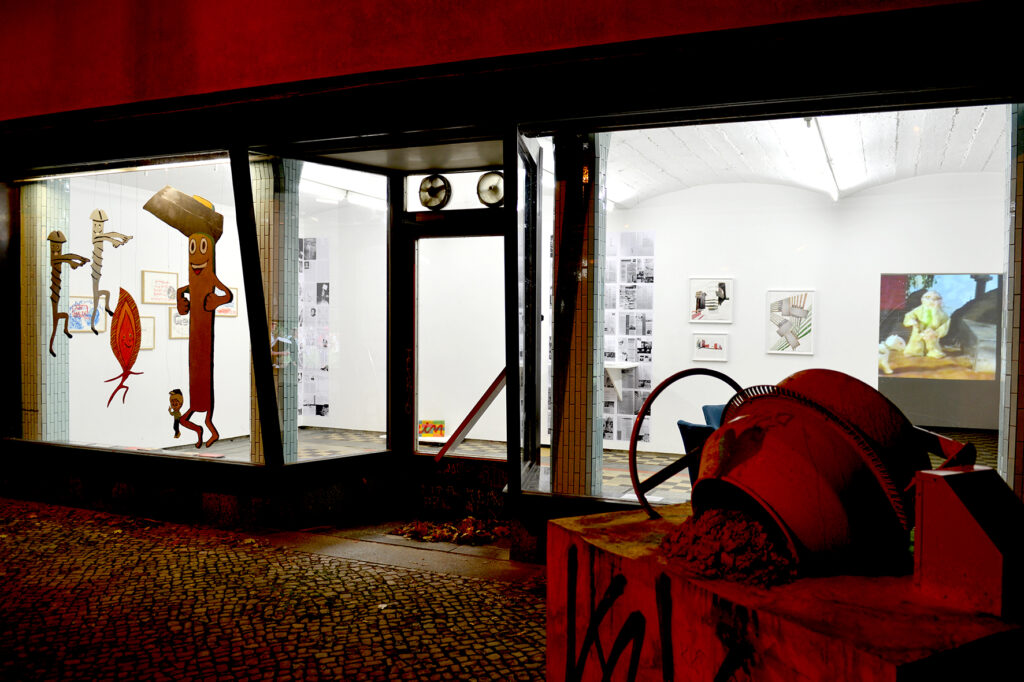
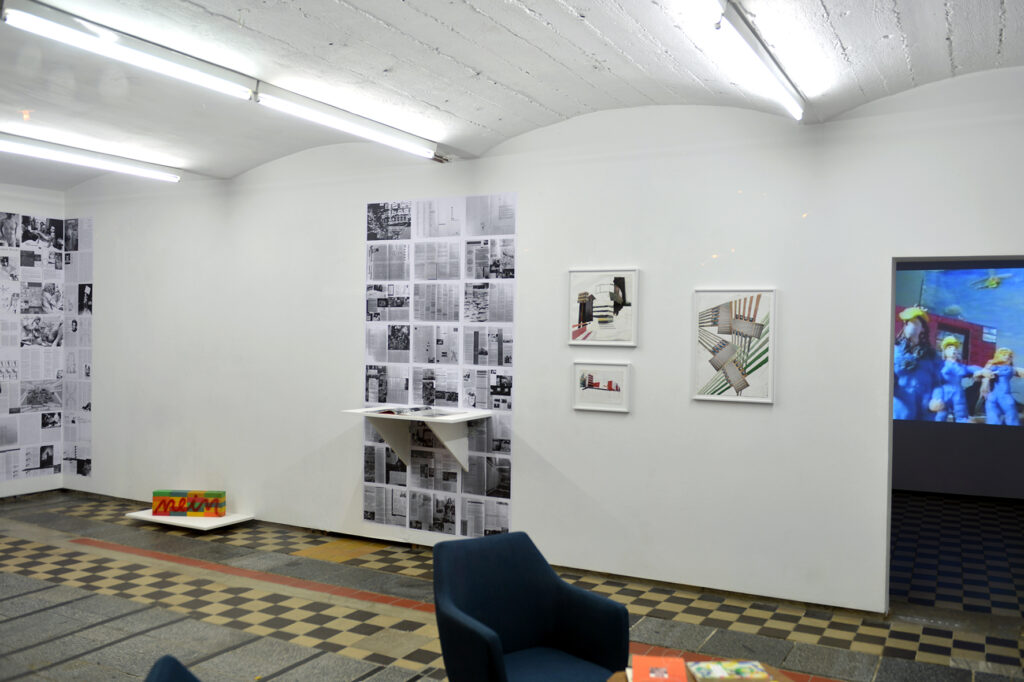
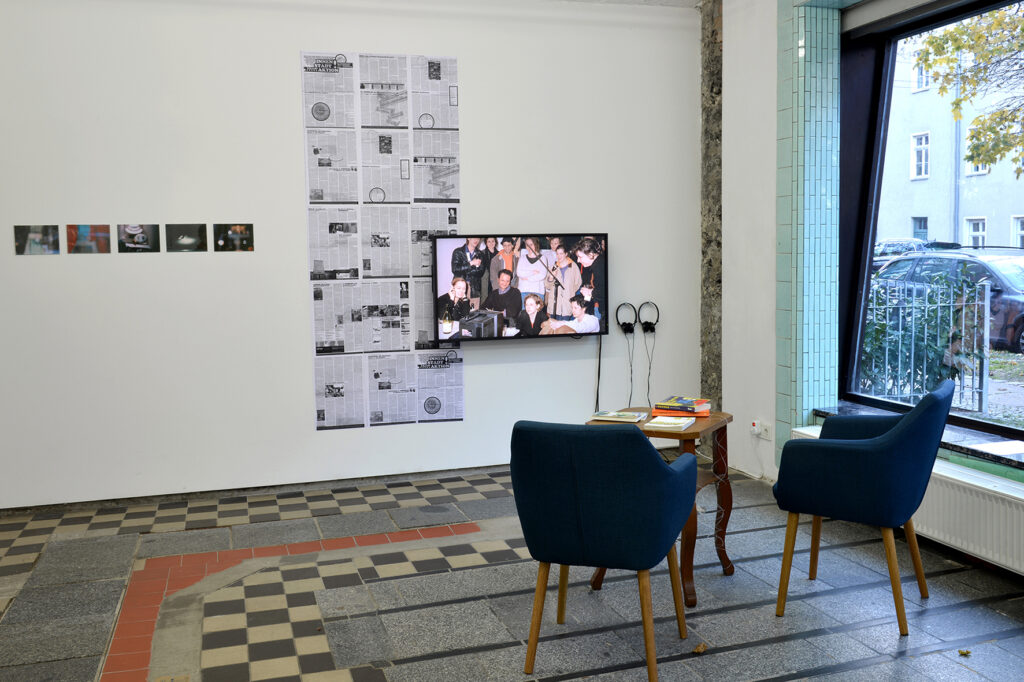
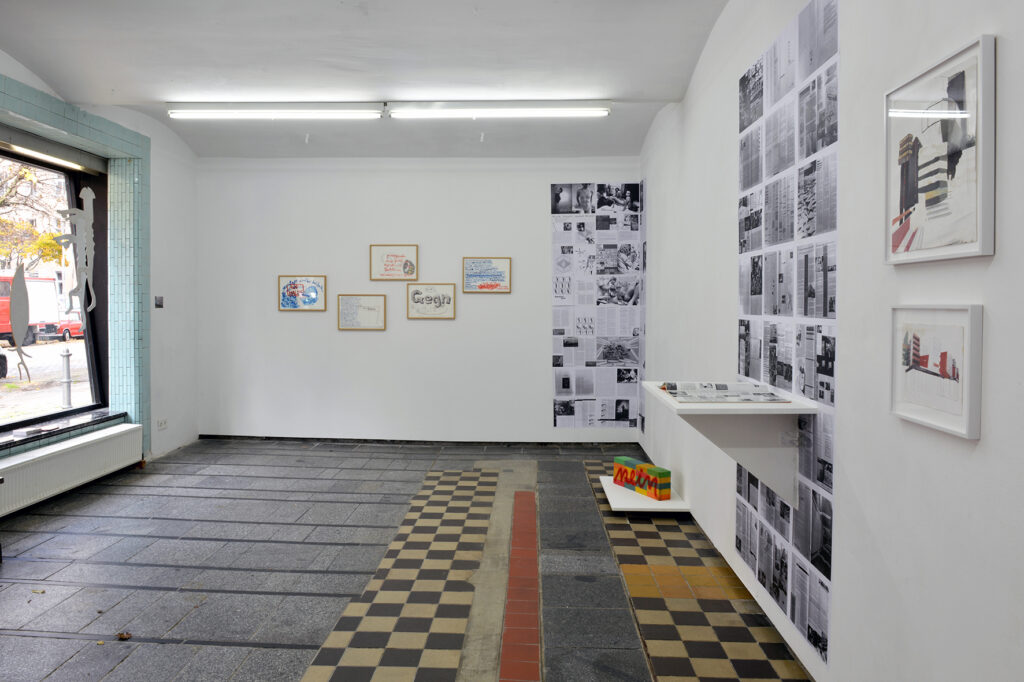
later the butcher presents the group exhibition Stadt und Knete. Positionen der 1990er Jahre, running in parallel with the solo exhibition by Amelie von Wulffen at KW Institute for Contemporary Art, Berlin. A collaboration between KW and after the butcher, the bear witness revolves around 4 collaboratively produced animation films: Infobox (1996), Wie eins zum anderen kam (1996), and Dice Krumme Pranke and Egoland (both 1997). The work Infobox by the Berlin artists' group Jaaaa & Protzband Nicolas Siepen, Siegfried Koepf & Martin Ebner & Gunter Reski, MicroStudio Surplus reads as a commentary of its time on the structural evolution of Potsdamer Platz in Berlin. The work too refers to the so-chosen "Infobox" pavillion, which was installed from 1995 to 2001 at Leipziger Platz.
In 1996, the group Gummi 1000 / MicroStudioSurplus produced the video work Wie eins zum anderen kam, which vitriolicly and ironically criticizes the major exhibition Nach Weimar at the Neues Museum Weimar, organized past Klaus Biesenbach and Nicolaus Schafhausen. The piece of work addresses the structural relationships between the Neues Museum and the Gauforum, with the latter beingness built in the National Socialist era, as well as the resulting legitimization of fascist architecture as an exhibition space for contemporary fine art.
Die krumme Pranke, a video work past Alice Creischer, Andreas Siekmann, Josef Strau and Amelie von Wulffen performs in the lineage of the archetype Derrick crime-series. Situated in Berlin, the visual vocabulary of this metropolitan thriller moves betwixt documentary shots and fictional animation. Domestic politics and the development areas of the 1990s deed as central motifs of this filmic montage, in which the artists shift from art practise to political activism and reverse.
Egoland from 1997, is a 55-second movie theatre spot from the A-Clip series. Collectively produced, the political messages of the A-Clips were kickoff inserted by various picture palace projectionists in Berlin in the commercial breaks earlier the main flick.
Taking place in 1997 and 1998 in different cities in Frg and in Switzerland the "Innenstadtaktionen" were activities organized with significant participation past political activists from the fine art context. Katja Eydel, who was also participating, documented some of the Berlin actions at the fourth dimension. For the exhibition, Ina Wudtke has put together the video Innenstadtaktionen (2020), consisting of Eydel'south photographs and new fragments of interviews with artists formerly involved in the activities. Kollektive Erinnerungen (collective memories) thus gives insight into the political context of the fourth dimension in Berlin and is a meaning testimony of the art production connected to information technology.
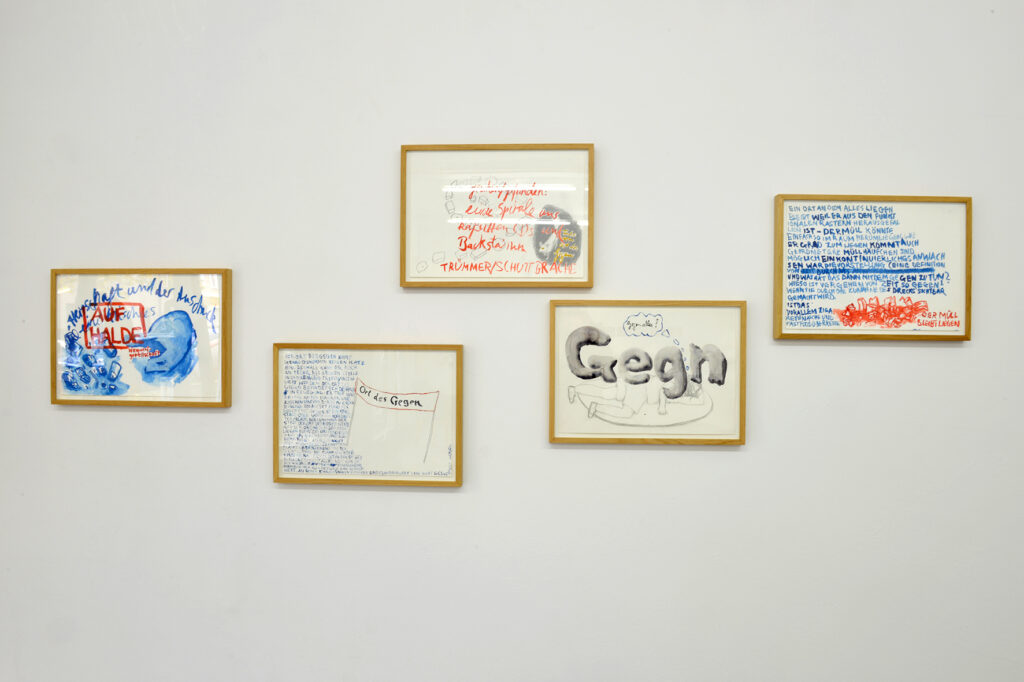
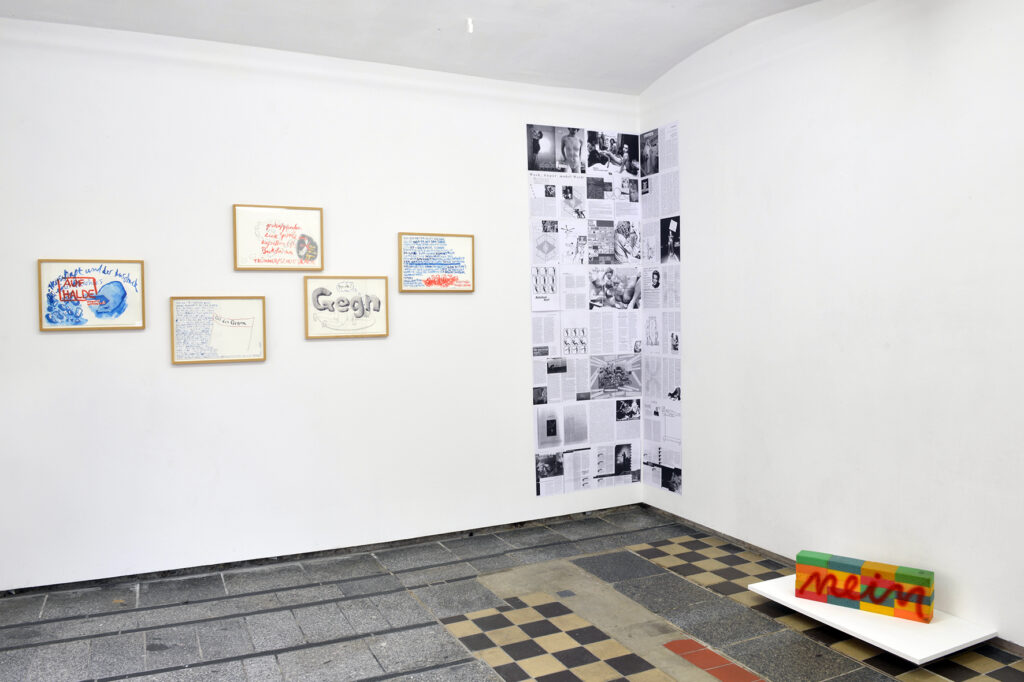
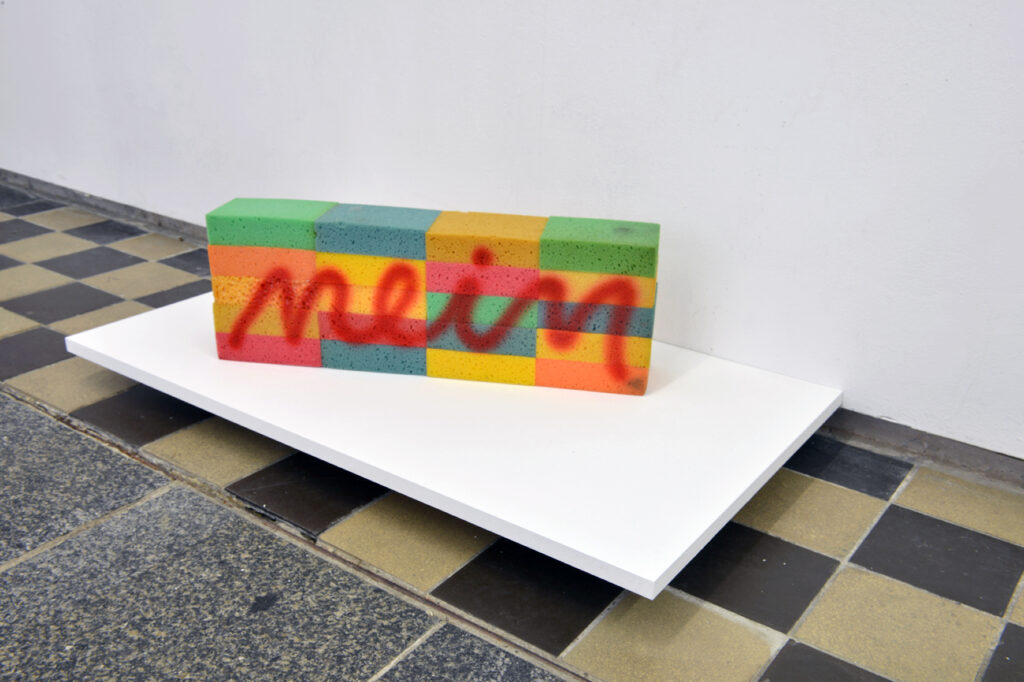
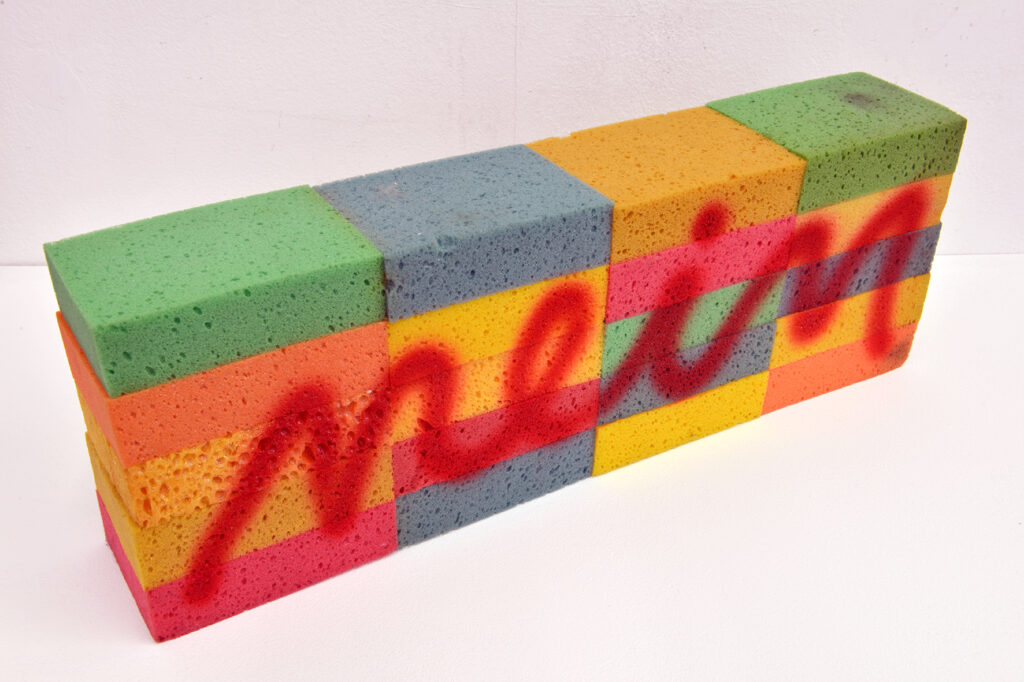
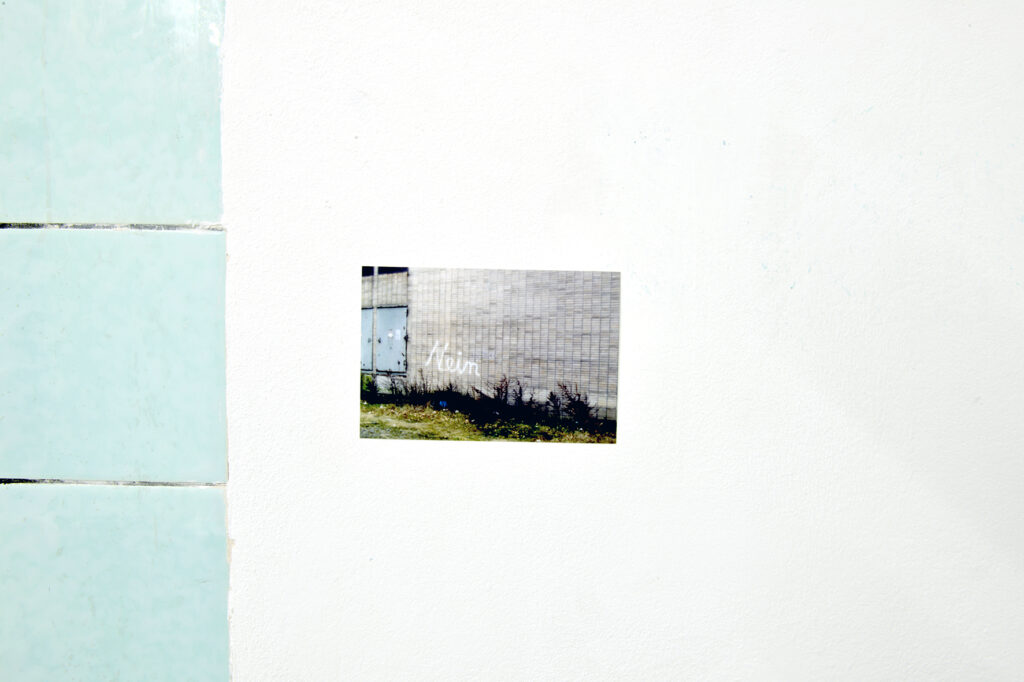
Hamburg based artist Annette Wehrmann (1961–2010) worked on a long-term project that explored urban infinite, titled Ort des Gegen. It followed the idea that the quality of a city depends on the number of undeveloped, freely available areas. She ended that, under neoliberal weather, the "Ort des Gegen" is able "to take the form of a thorough refusal of exploitation". Information technology becomes the "flipside" of utopia, "a place, where waste sediments and is not existence disposed" (from Annette Wehrmann's text Ort des Gegen, 2002). The exhibition includes five gouaches from the series too as the cream sculpture Nein.
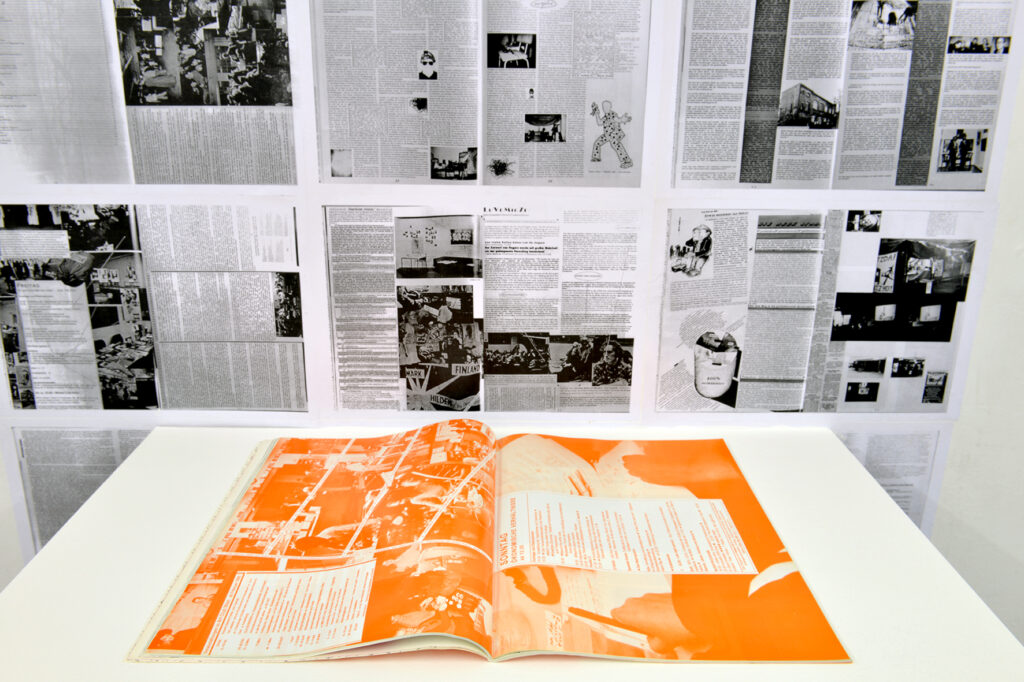
Equally ane of the first to publish Annette Wehrmann's Luftschlangentexte, the artist magazine NEID (1992–2004) besides documented fragments of the "Innenstadtaktionen" in Berlin. The exhibition features problems of NEID #4 and NEID #7.
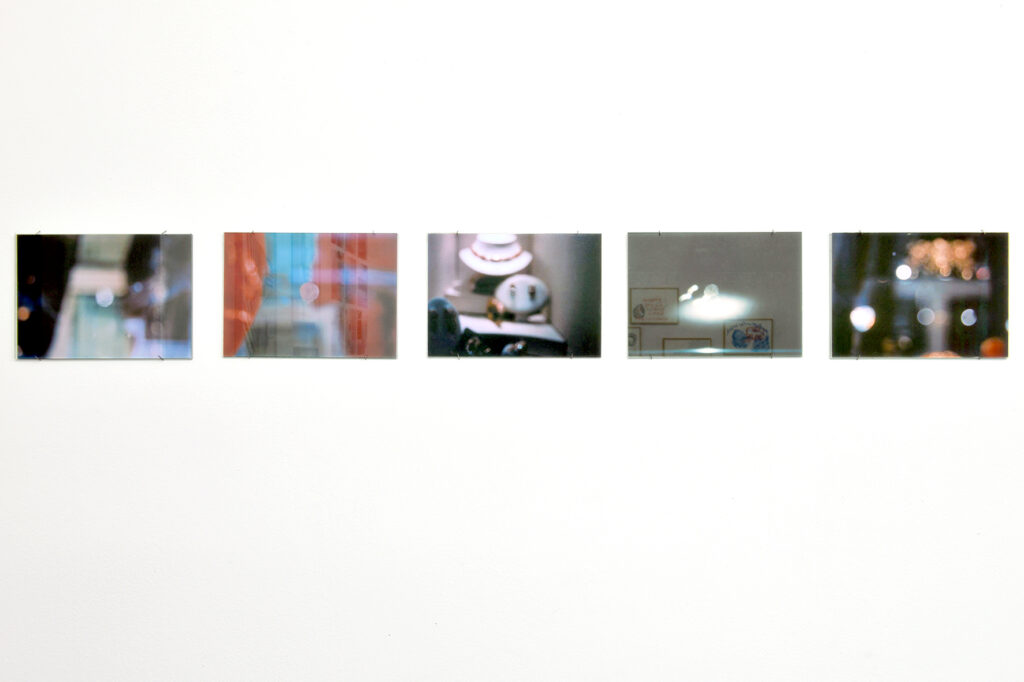
Farther, Stadt und Knete presents a series of photographs depicting fingerprints on window fronts of luxury boutiques from 1995 by Josef Kramhöller (1968–2000).
Alongside Amelie von Wulffen's collaboratively produced video works, the exhibition presents three photograph collages depicting buildings in East Berlin reflecting her enthusiasm for the Soviet modernism and the remaining parts of a store window installation from 1996. The plywood figures depict both found and invented logos of manual craft'south companies.
About the artists:
A-Clip, are political brusque films collectively produced by artists and activists for the cinema, in 1997 and 2000.
Jaaaa (Josef Strau, Amelie von Wulfen, Ariane Müller, Alice Creischer, Andreas Siekmann) was founded in 1996 in Berlin to collaboratively produce animation videos.
Gruppe Gummi K (Alice Creischer, Martin Ebner, Christoph Keller, Ariane Müller, Andreas Siekmann, Nicolas Siepen, Josef Strau, Klaus Weber, Amelie von Wulffen) emerged from the group Jaaaa in 1997 and continued working on video animations.
Josef Kramhöller (1968–2000) was an artist and author. He studied painting at the Akademie der Bildenden Künste in Munich and at the Chelsea College of Art and Pattern in London. His practice spanned operation, photography, painting, drawing, and text.
MicroStudio Surplus was the name for a temporary studio in Burgstrasse, Berlin. Information technology does not denote a fixed constellation of participants.
NEID was a queer-feminist mag founded in 1992 by Hans-Christian Dany, Claudia Reinhardt, Heiko Wichmann, and Ina Wudtke at the Hamburg Academy of Fine Arts. It was published past Ina Wudtke from 1995–2004.
Annette Wehrmann (1962–2010) was an artist and author. She studied Fine Arts at the University of Fine Arts in Hamburg and at Städelschule in Frankfurt. Her piece of work revolved around topics of urban space and forms of self-system.
Ina Wudtke, born 1968, is a conceptual artist living and working in Berlin. Her artist'south book The Art of Living, which addresses bug of gentrification, was published in 2018 by Archive Books, Berlin.
Amelie von Wulffen, born 1966, lives and works in Berlin, studied at the University of Fine Arts in Munich. Her practice entails painting, collage, cartoon, and installation. She was represented at the 50th Venice Biennale and Manifesta 5.
Funded by:
afterward the butcher would like to thank the Kienzle Fine art Foundation for the kind loan of Josef Kramhöller'south photographic works.
Michael Baers & Sophie -Therese Trenka-Dalton

Exhibition: October 9 to November 8, 2020
Open upon engagement: ina@later-the-butcher.de or 01783298106. Please wear a mask in the exhibition space.
On Oct 11, 2020 at 4 p.m. nosotros invite to an creative person talk. The result will take place in the courtyard,
registration required at: after-the-butcher
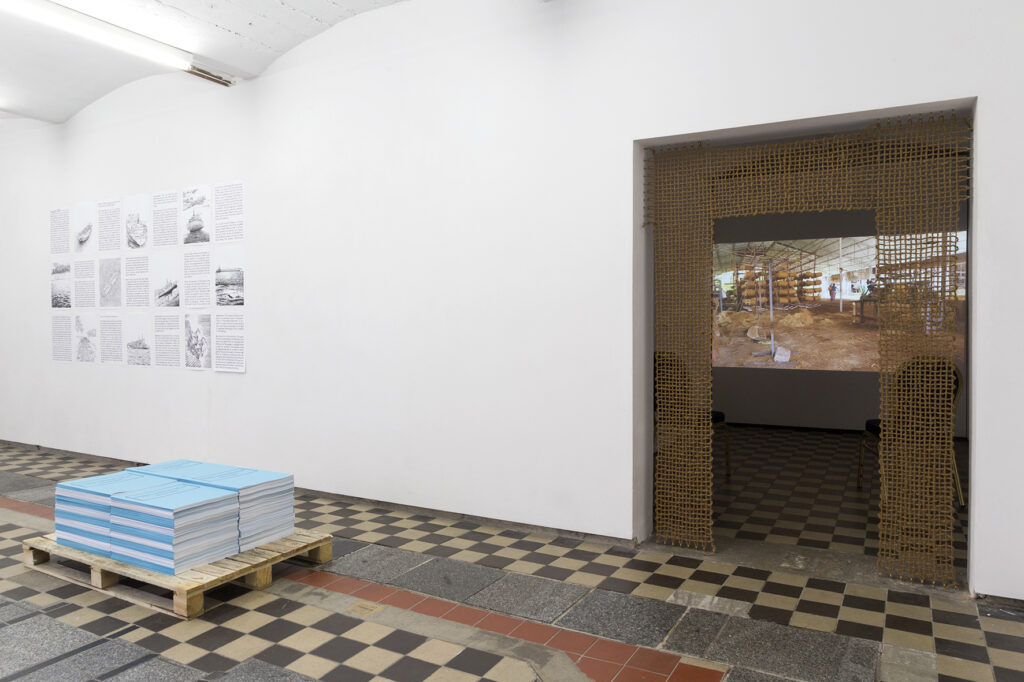
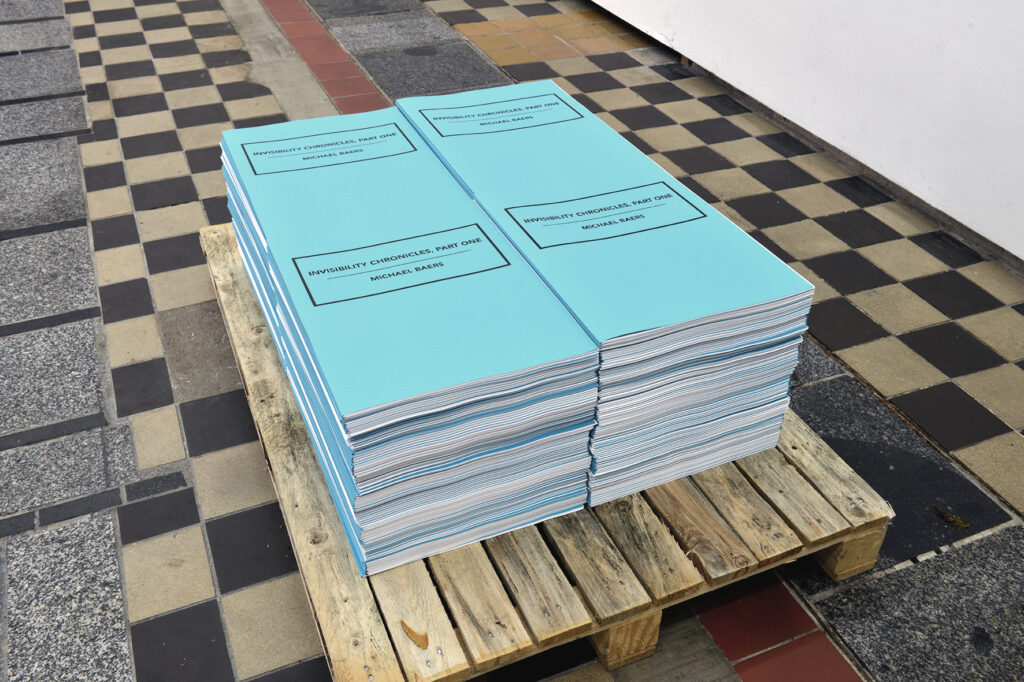
Invisibility Chronicles, Part One
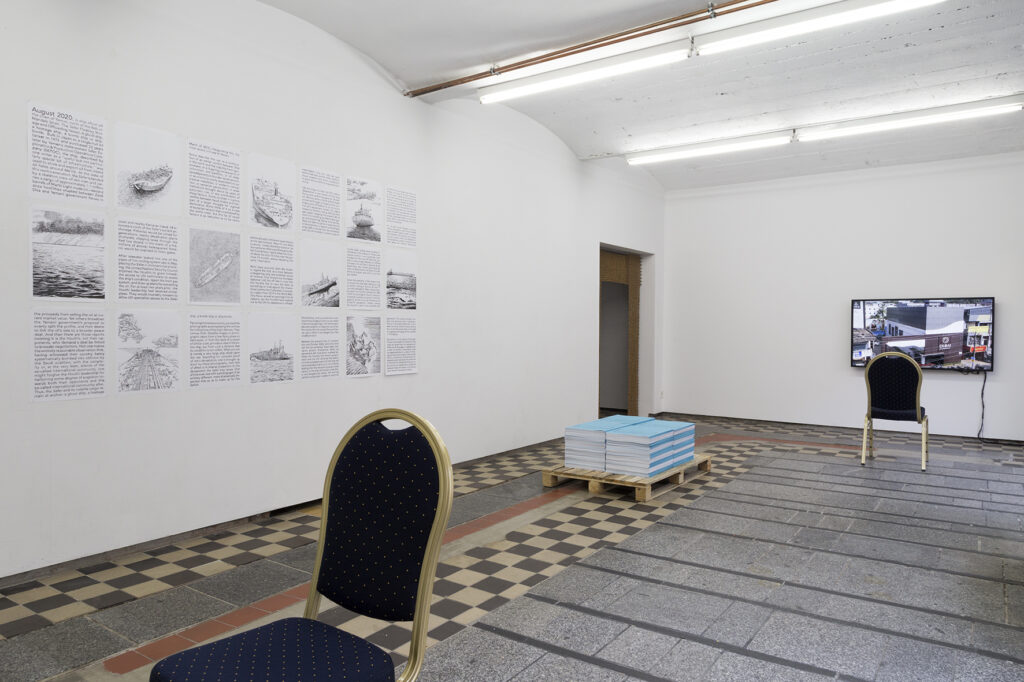
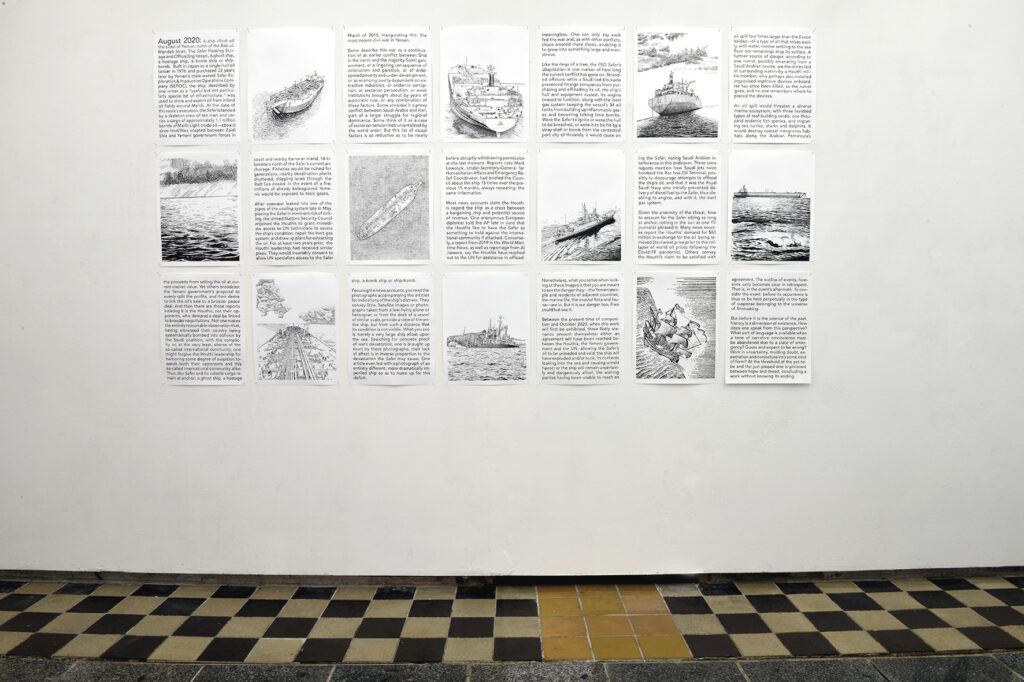
Why do some conflicts, situations, or events become well-known in Western civil society while others remain obscure? How does the mass media organize our understanding of the contemporary globe? What social and cultural consequences occur when stories of international relevance fall out of the media's hegemonic narratization of the globe? What advantage accrues to powerful nation-states by heightening the visibility of some stories while relegating others to this zone of invisibility? What enters into media soapbox and how it is framed is subject to a complex set of mechanisms, dictated in office by the geopolitical interests of powerful nations. Growing out of prior research on the unresolved disharmonize in Western Sahara, Invisibility Chronicles, Part Ane examines these mechanisms, focusing on a electric current situation where the international mass media news cycles has rendered a story with profound ecological implications invisible: the ongoing saga of the FSO Safer. Owned by the Yemeni land's state oil company and occupied by the Houthi rebels since 2015, this floating storage and offloading vessel shortly sits stranded off Yemen'south declension, its cargo of i.1 meg barrels of oil in imminent danger either of leaking or exploding—threatening the Ruddy Ocean with an ecology ending that would affect the people and environment of the region for generations. Michael Baers' examination of the FSO Safer story takes the form of a graphic essay detailing how the mass media's treatment of the story has reinforced a prevailing view of the conflict, before whisking it away to that place where formerly urgent news stories become when they cease being "news." In doing so, he forces the viewer to occupy, in the words of Avery Gordon, "that distressing and sunken couch that sags in but that place where an unrememberable past and unimaginable future force us to sit day after day." This work has been produced in a limited edition, bachelor for free to the viewing public.
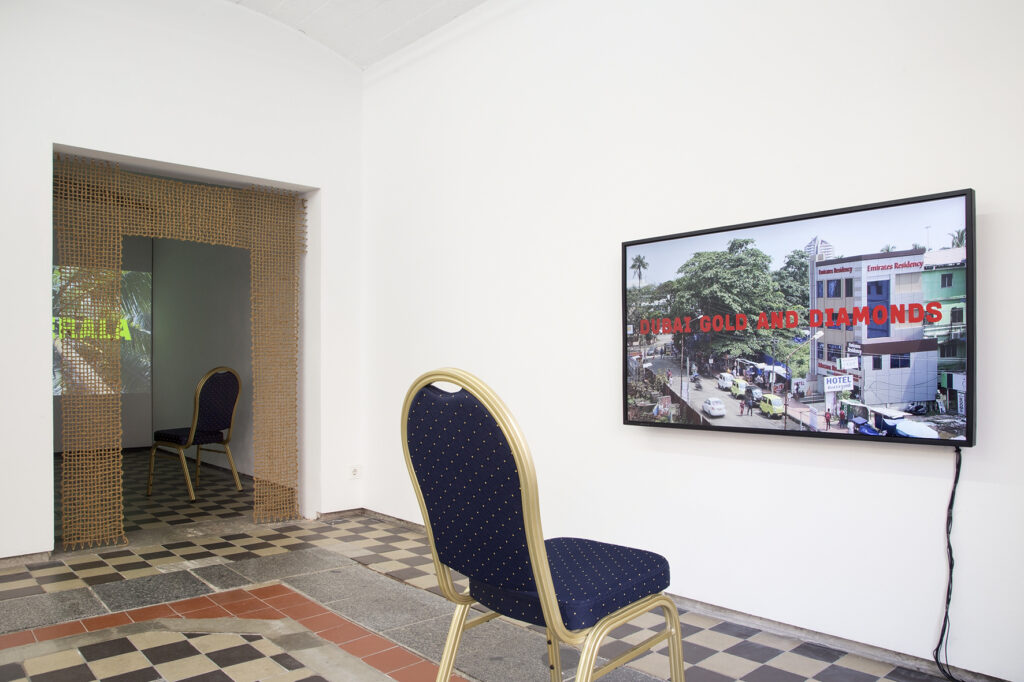
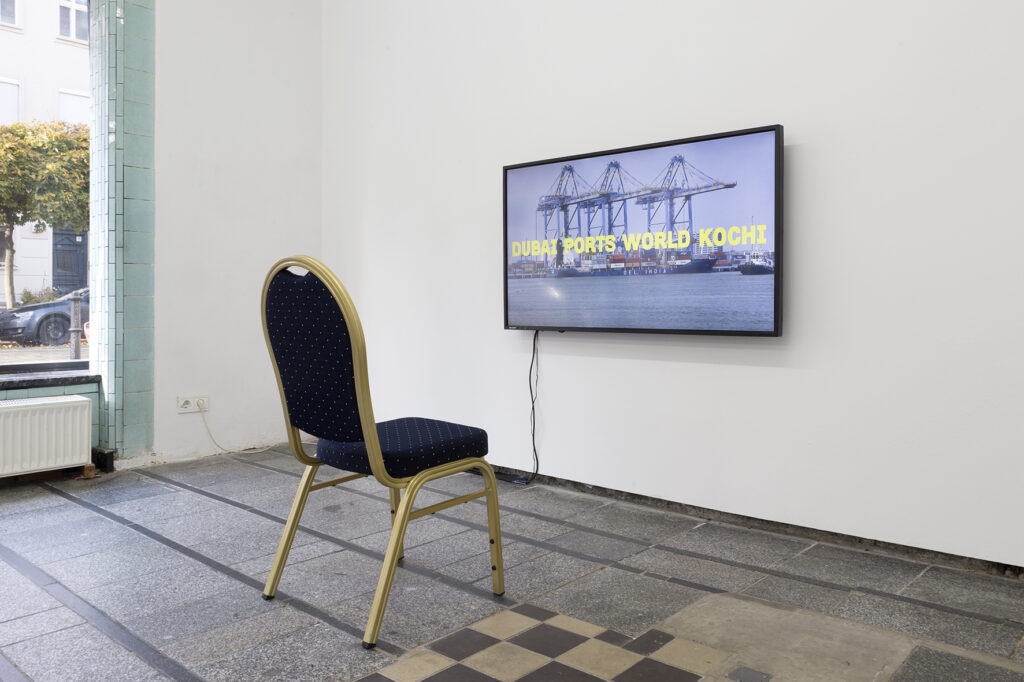
Dubai Gold, Coir Kerala
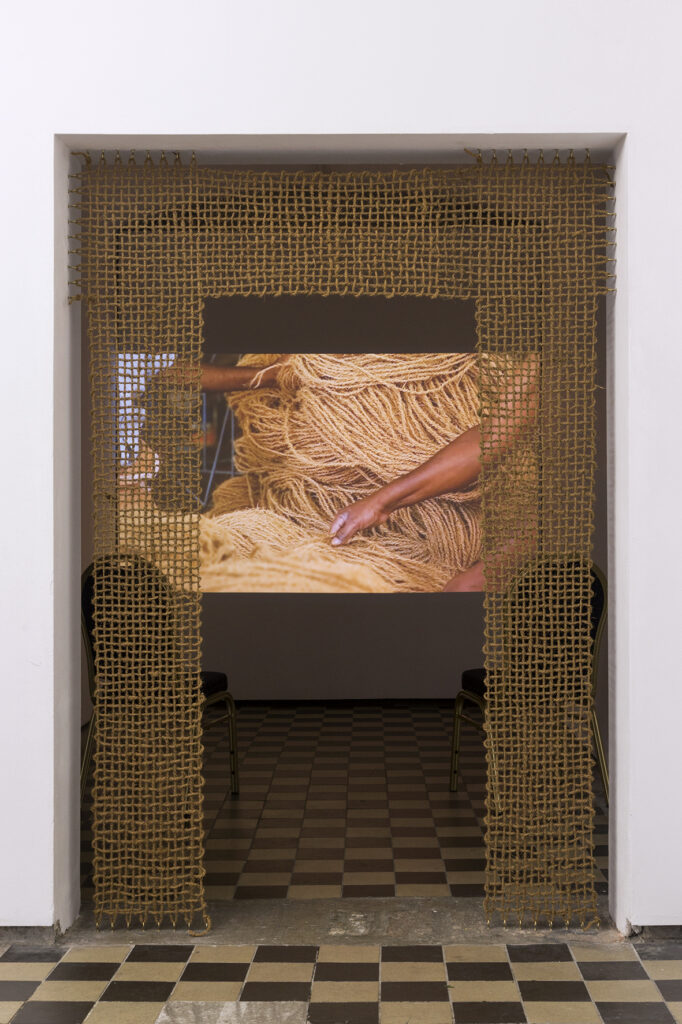
With the installation Dubai Gold, Coir Kerala, Sophie-Therese Trenka-Dalton presents three current video works created between 2017 and 2019 in the South Indian state of Kerala.
The two videos, Dubai Ports World Kochi (2018) and Dubai Gilded and Diamonds (2018), focus on the connection between Kerala and the United Arab Emirates, a continuation of her long-term project Dubayyland (2009–2015). Through her trips to the UAE, the artist learned about the special relationship between the ii regions. Since the 1970s, the Emirates and other Gulf States have been a main destination for labor migration from Kerala. Decades of substitution at present shape both the personal biographies and economic construction of Kerala. The videos evidence places that refer to this connection, such as the container port of Kochi, operated by the Emirati company Dubai Ports World, or the numerous stores and advertising posters named after cities in the Emirates, which also often utilize iconic motifs such equally the Burj Khalifa.
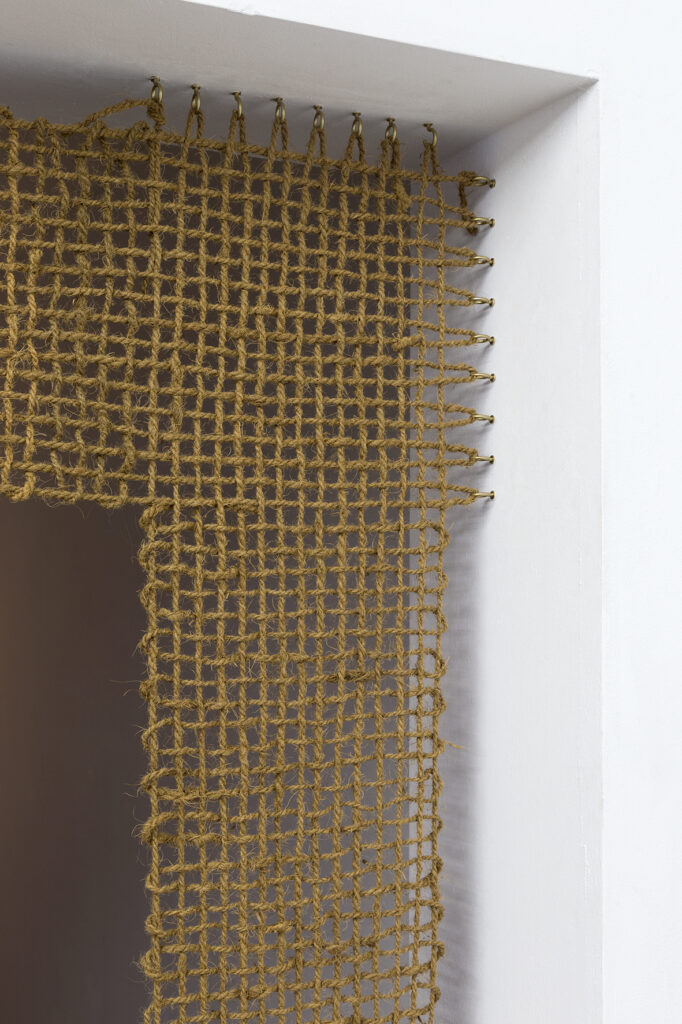
The video work Coir Kerala (2019) documents how coconut cobweb (Coir) is processed in small village workshops. Coir mats are an of import regional production of tropical Kerala and are used both for domestic use and as geotextiles for land consolidation. The small-scale enterprises are organized equally cooperatives. Most employees are women, who earn a little coin in improver to household supplies. However, due to the low wages, the coir trade lacks a new generation of workers. In recent decades, unionization has led to improvements in working conditions, but at the same time the coir sector has non been sufficiently modernized, equally this would mean the loss of local jobs, with dire consequences for the economical rest of village life structures in Kerala.
The video works were realized with the back up of the Goethe-Institut / Max Mueller Bhavan Bangalore and the Kochi Biennale Foundation.
Michael Baers
(* 1968) is an American creative person and writer based in Berlin who has exhibited his artistic work in Federal republic of germany and abroad, including at the Haus der Kulturen der Welt, Museum Angewandte Kunst Frankfurt am Main, the Van Abbemuseum, and Künstlerhaus Halle für Kunst & Medien Graz. He received his PhD from the Akademie der Bildenden Künste Wien in 2014 from its dedicated artistic research department. Since 2010 much of his piece of work has focused on the cultural outcomes of disharmonize irresolution in the Middle East and Africa. In 2014, he published a lengthy graphic novel/documentary, An Oral History of Picasso in Palestine, about the 2011 Picasso in Palestine project online with the Haus der Kulturen der Welt. It was released in book class by adocs verlag (Hamburg) in 2016. He has also published many essays on contemporary art and artistic inquiry, cultural politics, and urbanism, contributing to a variety of volume and publication projects and internationally recognized journals such as the due east-flux journal, Vector – critical research in context, and Retentivity Studies. He is currently an affiliated researcher at the Leibniz Zentrum Moderner Orient (ZMO) in Berlin.
Sophie-Therese Trenka-Dalton
(*1979 Berlin) works with installation, photography, and video. In long-term projects, she investigates cultural appropriation processes that arise in the course of the implosion, shifting, and new formation of power centers.
In 2016, she published her first catalog PALMS (Textem Verlag), which consists of works on the reception of ancient Mesopotamia, the contempo history of Iraq, and the compages of the United Arab Emirates. In 2017, she traveled to Southward Bharat to trace the relationship betwixt Kerala and the Gulf States. Currently the creative person is working on the realization of the upshot series The Sky was the Limit – Art and Astronomy at the Archenhold Observatory, which volition have place in the summer of 2021.
Solo and group exhibitions (extract): Kochi Biennale Foundation, Kochi, India (2018), Hamburger Bahnhof, Berlin (2018), Neuer Berliner Kunstverein (2017 & 2006), Alserkal Avenue, Dubai (2017), KW Institute for Contemporary Fine art, Berlin (2015), Heidelberger Kunstverein (2014), Kunstraum Michael Barthel, Leipzig (2012), Serpentine Gallery, London (2011), Klaus von Nichtssagend Gallery, New York (2011), DEPO, Istanbul (2010), TÄT, Berlin (2009), Nice and Fit Gallery, Berlin (2008), Foundation d`Enterprise Ricard, Paris (2008), HarrisLieberman Gallery, New York (2008), Institute in the Glass Pavilion of the Volksbühne am Rosa-Luxemburg-Platz (2007).
Funded by:

Here yous find a review past Norman Saadi Nikro,
Inquiry Fellow at Leibniz-Zentrum Moderner Orient
Berlin.
Claudia Reinhardt & Cornelia Herfurtner
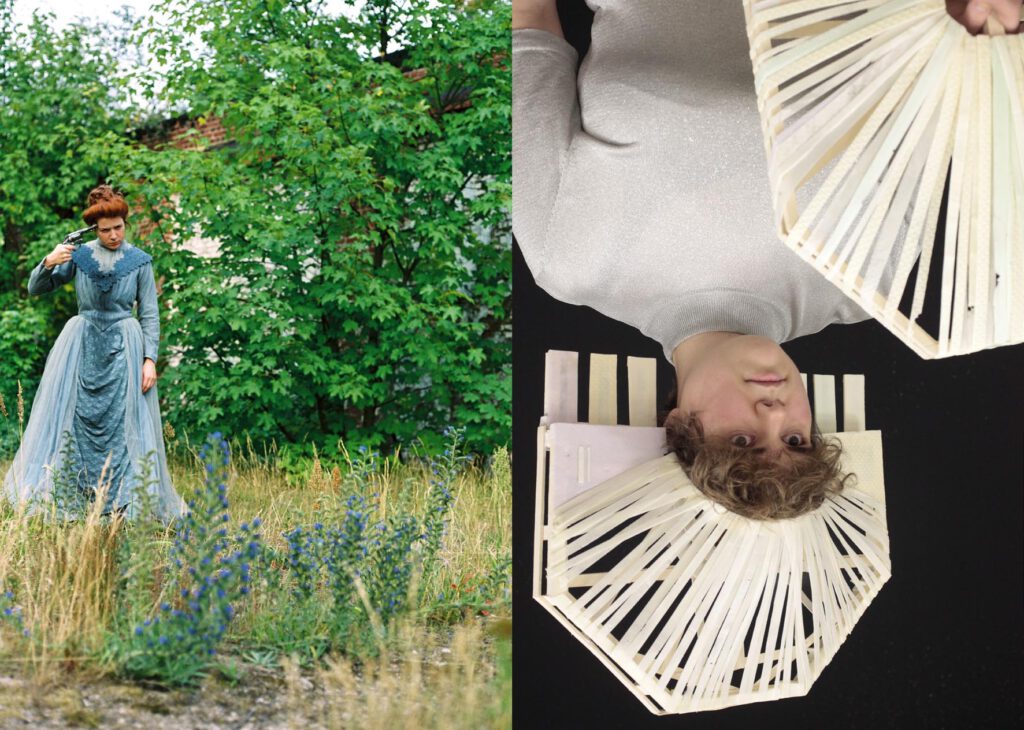
exhibition: September 5 – Oct 4, 2020
Due to the current situation no opening will have place. We invite y'all to visit the exhibition in the presence of the artists. Email after-the-butcher to request your visit. Delight article of clothing a mouth and nose protection mask when inbound the exhibition space:
September 4, vi-x p.m., September 12, 19, 26 and October 3, 3-six p.g.
September 19, 7 p.m. Book Release: Witwen/Widows, Claudia Reinhardt, The Green Box, 2020
Lord's day October 4, Finissage 3-8 p.k. 3D moving-picture show screening at 6 p.m. ofFlipping the Stationary Car, 2018 past Cornelia Herfurtner, David Iselin-Ricketts, John Allan MacLean (45min). Visit but by prior appointment until latest Sunday October 4, eleven p.m. at: ina@after-the-butcher.de
Passive Bewaffnung (Passive armament)
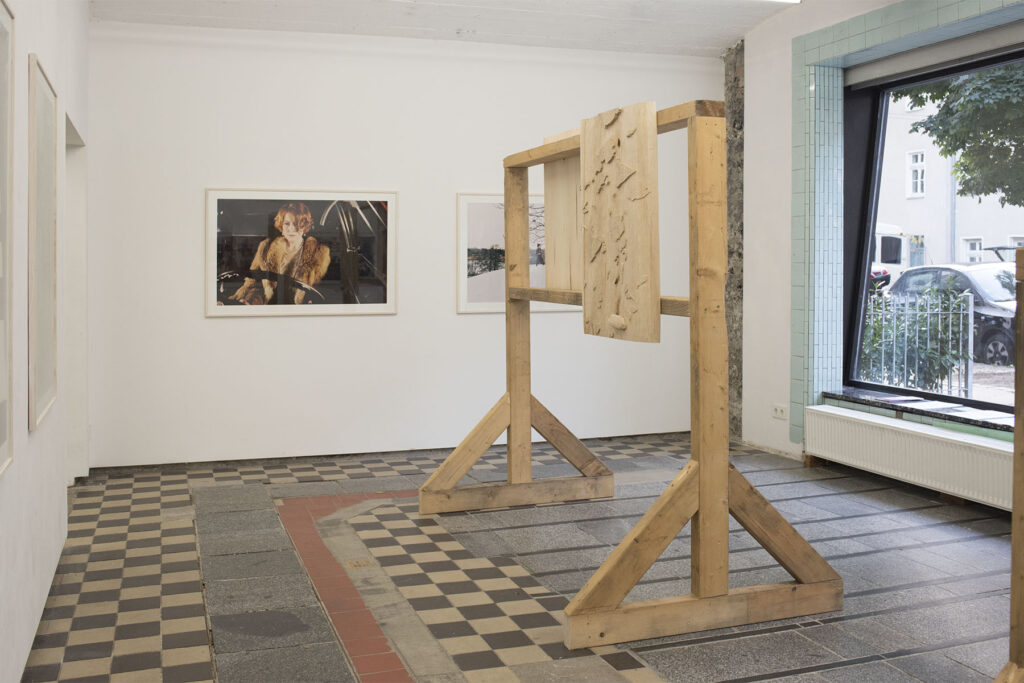
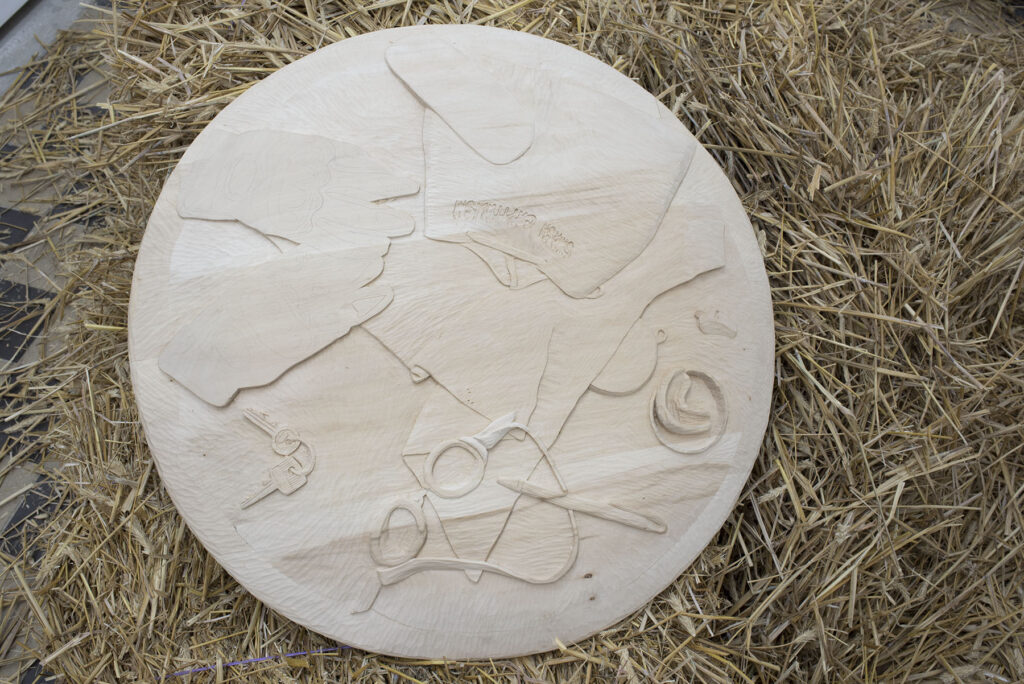
Legally speaking, we currently commit an criminal offense with every organized gathering of people. Cheers to Covid-nineteen, Frg is at present passively armed, masks and protective screens concealing our faces, obligated to disguise. What happened? After 1968, protesters in 1970s Federal Republic of Germany increasingly began to utilize face masks in social club to protect their personal rights – subsequently all, taking to the streets risked recognition and subsequent dismissal from work or school. Ever since the passing of anti-terrorist legislation in 1977, masked protestors are not simply deemed to expect, just to provoke violence. With the nativity of 'passive Bewaffnung' came the prohibition of masked protests. Following Brokdorf and the anti-nuclear motility, laws were tightened: Anyone wearing protective gear in anticipation of police violence was now considered passively armed. Meanwhile, e'er since the GSG nine unit, their counterpart's advent has grown to resemble military machine expeditions against their own citizens with each May ist protestation – or the G20 peak. Protestors, on the other hand, are called to avert helmets, goggles, protective gloves, mouthguards – and to best leave their keys at domicile if they are on their mode to a protestation. Now, the issue of active self-protection against potential threats is frail to say the least: Who wears masks for the do good of or protection against whom? Who or what constitutes the adversary? Cornelia Herfurtner's sculpted reliefs are still lifes of a history of the Frg about insurgence and repressive state power – a history to be continued.
Killing Me Softly
"To exist nowhere, to stay nowhere. Diving, resting, moving without try of force – and one solar day reflecting, reappearing, walking through a clearing […]. Start with the showtime." (I. Bachmann, Undine leaves)
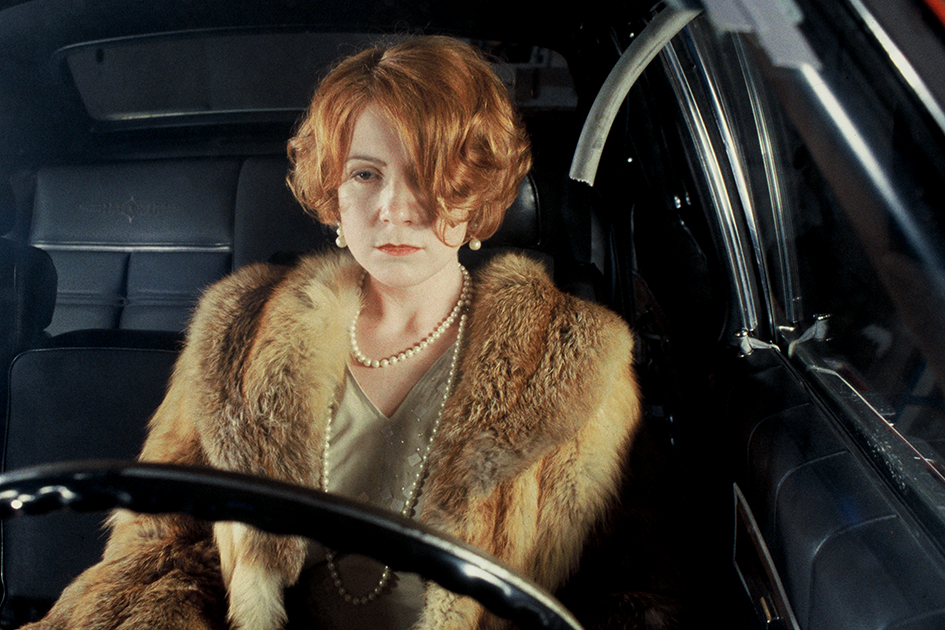
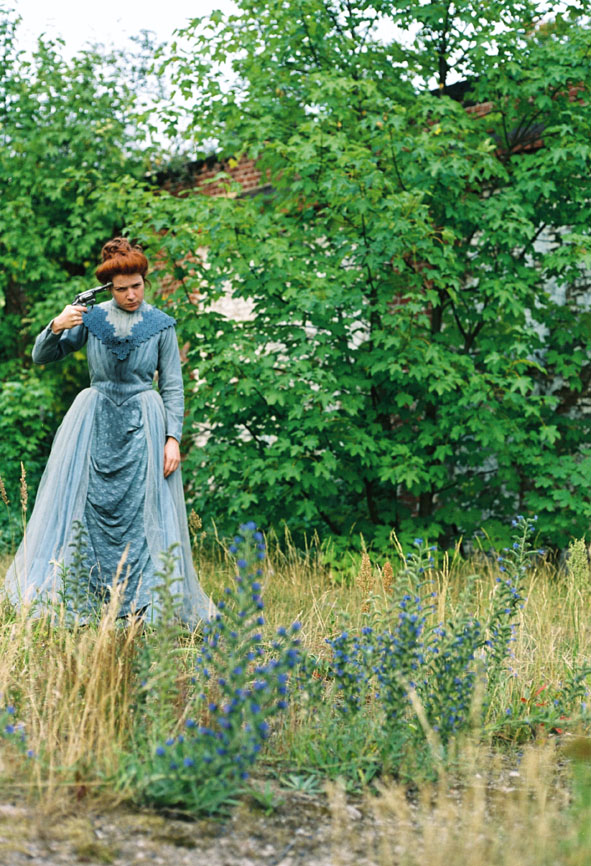
Suicide is a grade of violence, just also of freedom. Betwixt 2000 and 2004, Claudia Reinhardt photographically re-staged 10 suicides of well-known artists* – personalities who fascinated her and whose piece of work and life influenced her in her piece of work. Equally a kind of personal tribute, Reinhardt allows fiction and reality to merge into one another, researching for each photo both in literature and in the athenaeum what exactly drove those women* to say goodbye to life. The motives and methods are very dissimilar: in that location is the planned and precisely executed suicide, for example in the example of Sylvia Plath or Anne Sexton, and in that location is the slow destruction of 1'due south own body, such as Ingeborg Bachmann'due south addiction to pills and alcohol. Reinhardt chooses a thoroughly psychological approach to her role models by slipping into the role of the dying herself: she reenacts the ten deaths, the moment equipped in every detail and allows herself to be photographed. If that adjective were not in exact opposition to what is depicted hither, the scenery could indeed be described as "alive" due to its filmic graphic symbol. What caused these women* to oppose, to withdraw from life? Unfortunately, the possible reasons nonetheless seem to exist present: patriarchal, physical violence, fascist systems, lack of equal rights and recognition of their works, to name but a few. Without wanting to glorify suicide, Reinhardt'due south photographs therefore also capture a moment of greatest self-determination.
"But I tin can't go like this. And then let me say good things to you lot one time again, so that you won't become divorced like this. So that nothing gets divorced." (ibid.)
Nadja Abt, Berlin, 2020
Claudia Reinhardt
(* 1964 in Viernheim/Southward Hesse) studied at the University of Fine Arts, (*1964 in Viernheim/South Hesse) studied at the University of Fine Arts Hamburg. From 2000–2012, she taught every bit a professor in the section of photography at the National Fine art Academie in Bergen, Norway. Reinhardt became known, amongst other things, through her photographic work Killing Me Softly – Todesarten (Aviva Verlag, Berlin 2004), a serial of photographs dealing with female artists who killed themselves. Reinhardt stages theses suicides using herself as a model. The work No Place Like Home (Verbrecher Verlag, 2005) is about the meaning of origin and identity. The work Tomb of Love (Verbrecher Verlag, 2016) again deals with the topic of suicide, staging couples who their own lives together. The work Widows and Widows is nigh mourning and remembrance, a documentary and conceptual photographic work, which will be published by The Green Box, Berlin, in 2020. Exhibitions: Haus am Kleistpark, Berlin (2018); Kunstgeschichtliches Museum, Osnabrück (2017); Galerie Malopolski Ogród Sztuki, Krakow (2016); Galerie im Körnerpark, Berlin (2015); Corean Art Museum, Seoul (2015); Galerie F15, Moss, Kingdom of norway (2015); Gimmicky Art Museum, Roskilde (2015); Fotogalleriet Format, Malmö (2014); Meta Business firm, Phnom Penh (2011); Kunsthalle Memmingen (2010); IDFX, Breda Photo Festival, Breda (2007); Micro Museum, Zurich (2009); Brooklyn Museum, New York (2004) and others.
Cornelia Herfurtner
(*May viii, 1987) is an creative person and organized in the Interventionist Left. Every bit part of the alliance Disarm Rheinmetall, she works against arms production, artillery exports and Germany's largest arms producer Rheinmetall. As an artist, she works under her civil name equally well every bit with the artist group Michelle Volta and the publishing house and bookshop b_books. Her most recent projects include a series of photographs entitled freedom and command of others (including myself) (published in starship #19) and the collectively taught seminar Self-System and University (with Ernest Ah and Anastasio Mandel, Berlin Academy of the Arts). Her video essay Frauen verlassen das Museum (in collaboration with David Polzin) can be seen at the Mitte Museum in Berlin-Wedding until January 2021.
Funded by:

Julia Oschatz & Sonja Hornung
exhibition: July 31 – Baronial 30, 2020
Due to the current situation no opening volition have place. We invite you to visit the exhibition in the presence of the artists:
July 31, half-dozen-10 p.k. and August ii, 3-6 p.1000.
Email subsequently-the-butcher to request your visit. Please wear a rima oris and nose protection mask when entering the exhibition space.
THEY WANTED TO MOVE / THEY FOUND THEY COULD Not MOVE / OR RATHER THAT Motion WAS Only POSSIBLE IN / THE PREORDERED DIRECTION, THROUGH SPACES ALREADY SHAPED TO Conform THEIR Motion / AT THE REQUIRED SPEED, IN THE REQUIRED Fashion / SO, AND NOT Then; / Here, AND NOT There, ETC. / SO IN FACT, In that location WAS NO Real Movement, ONLY REPETITION, Peradventure SLIGHT VARIATION, WITHIN THE GIVEN Structure. / AND IN THAT SENSE, THERE WAS NO REAL Motility, Just REPETITION, MAYBE SLIGHT VARIATION, IN THE PRE-GIVEN STRUCTURE.
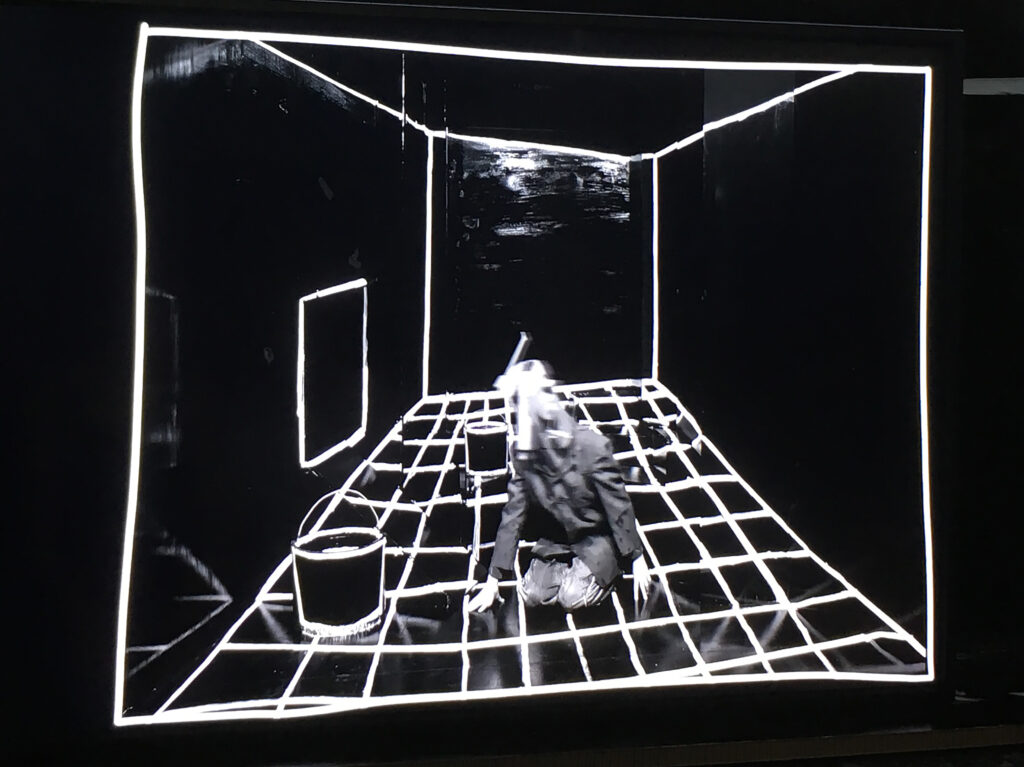
Julia Oschatz's work Unter Tagen is a video installation developed for after the butcher thematising both the everyday influence of space on human movement and action, besides as the effort to change this dynamic.
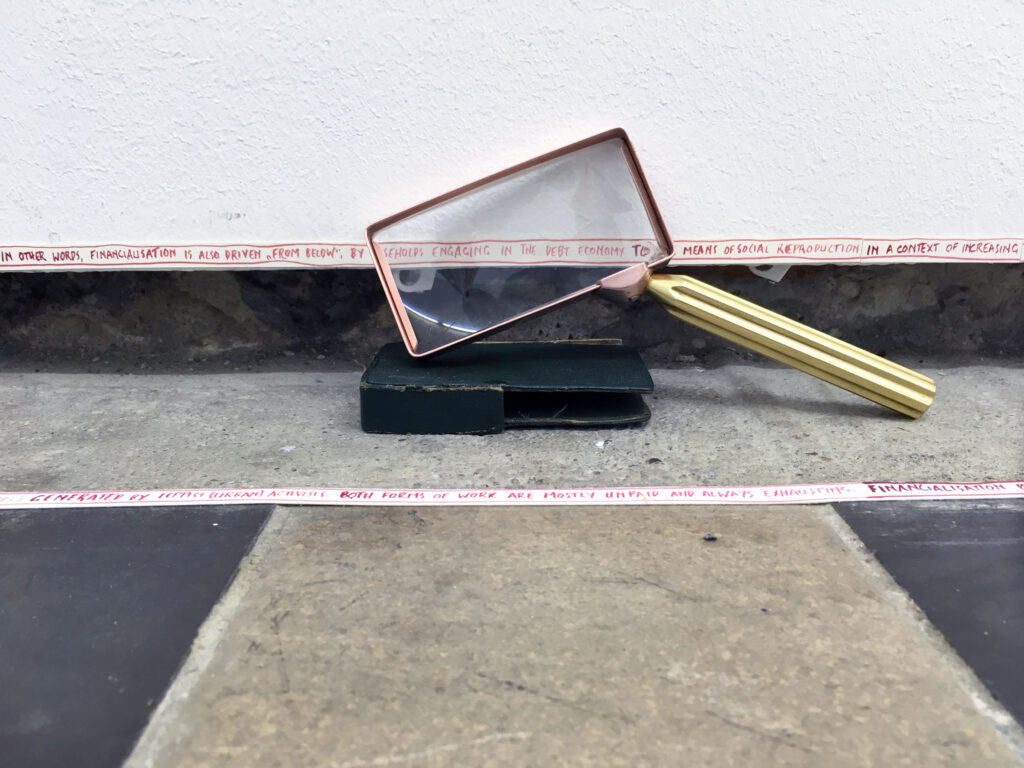
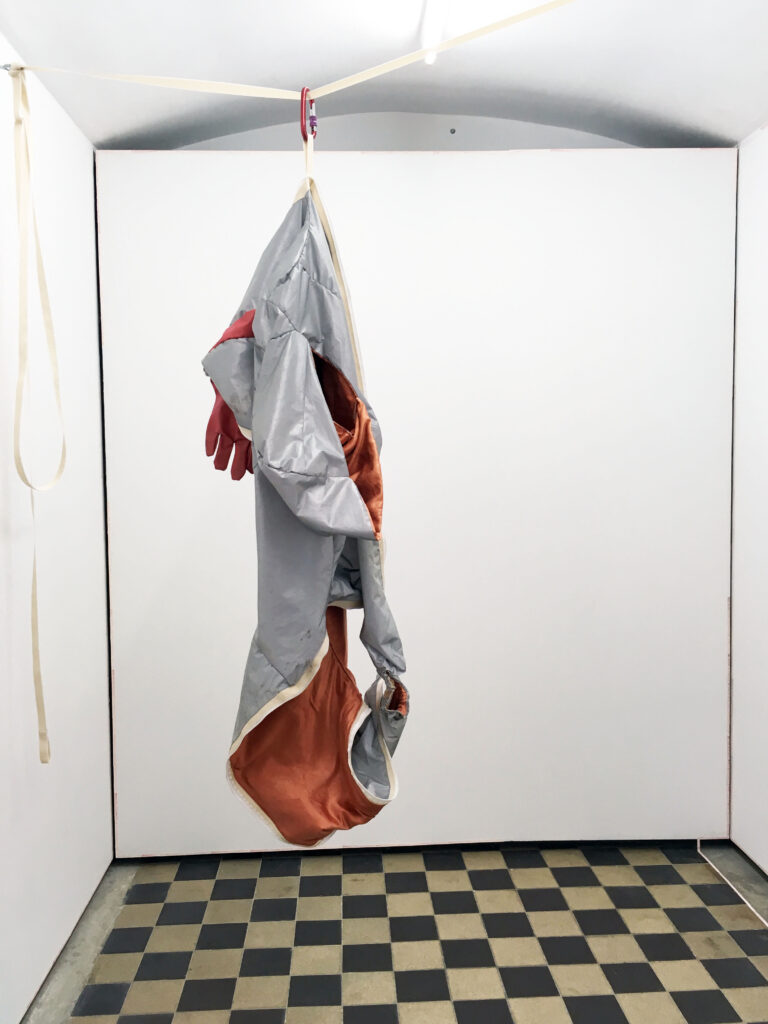
Sperre III is the third in Sonja Hornung'south series of works parting from Varvara Stepanova'south (1894-1958) search for a 'uni-course' that would erase the gendered division of labour. Each iteration of Sperre consists of a singular garment arising from a specific urban context or crunch, and texts compressed into aquarelle drawings. Sperre III thinks through financialisation and its 'collateral' effects on urban spaces and bodies gendered female.
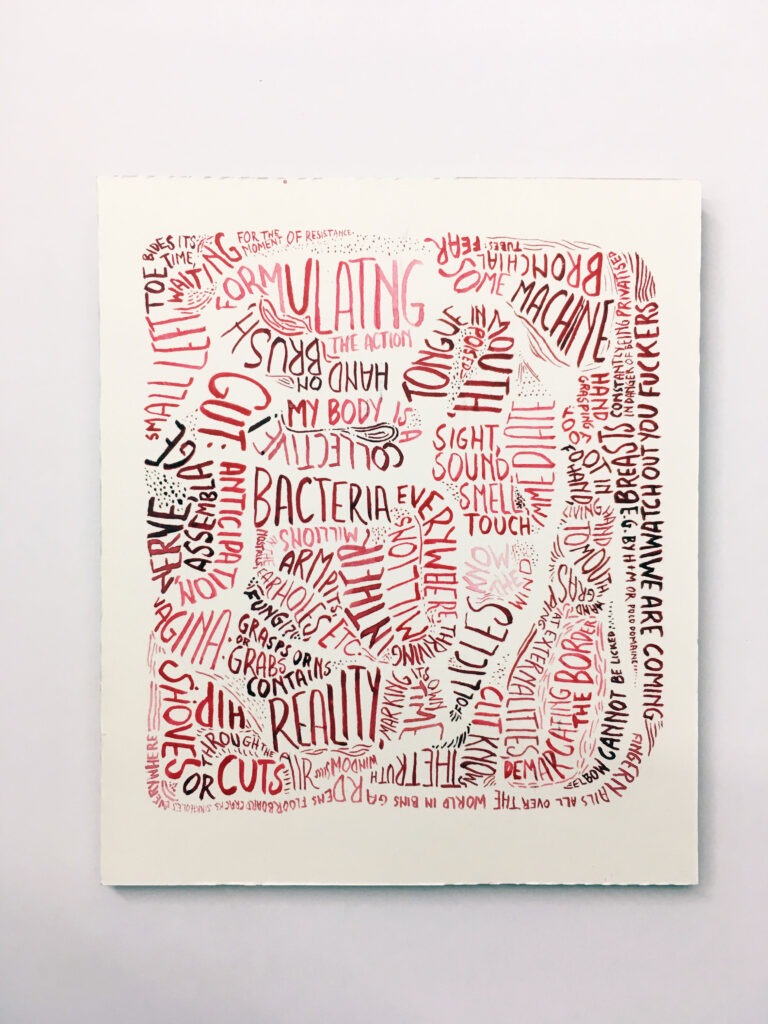

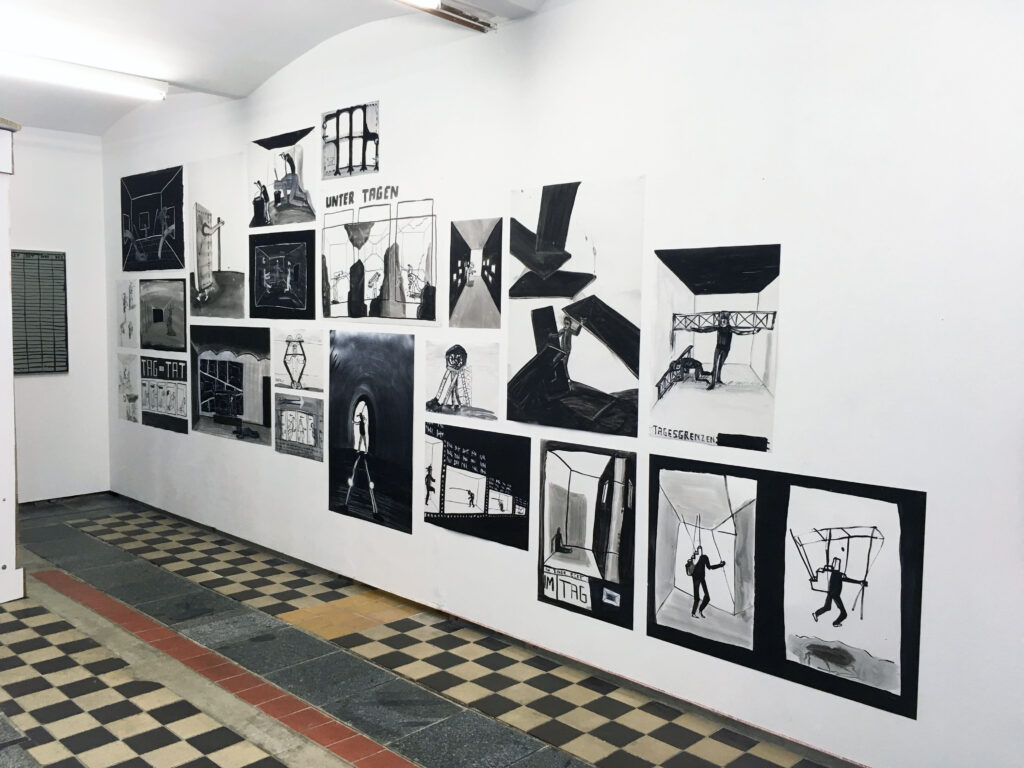
Julia Oschatz was born in Darmstadt in 1970 and lives in Berlin and Sandau an der Elbe. Aslope numerous exhibitions of her videos, drawings, paintings and installations – most recently at Artbox Dresden, Kunstverein Hannover, and Berlin'south Kupferstichkabinett – she also makes ready designs, currently for Hamlet at Proverb Gorki Theater, Berlin.
Sonja Hornung was built-in in Birrarunga/Melbourne in 1987 and lives since 2012 in Berlin. Her installations, drawings, and collaborations – for example with COPS (Corporation of People's Situations) and Kollektiv ten-embassy – have been shown at, among others, Haus der Kulturen der Welt, District Berlin, and Forum Stadtpark (Graz). Currently she is an Artist-in-Residence at Q21/MQ Vienna.

Funded by:
Martin Haufe
Minze Tummescheit & Arne Hector (cinéma copains)

exhibition: May 29 – June 10, 2020
Due to the current situation no opening will take identify. We invite you to visit the exhibition in the presence of the artists:
Sa June half dozen/ Su June seven / Su June 14 / Fr June 19 / Su June 21, 3-half-dozen p.m.
Email after-the-butcher to request your visit. Please vesture a mouth and nose protection mask when entering the exhibition infinite.
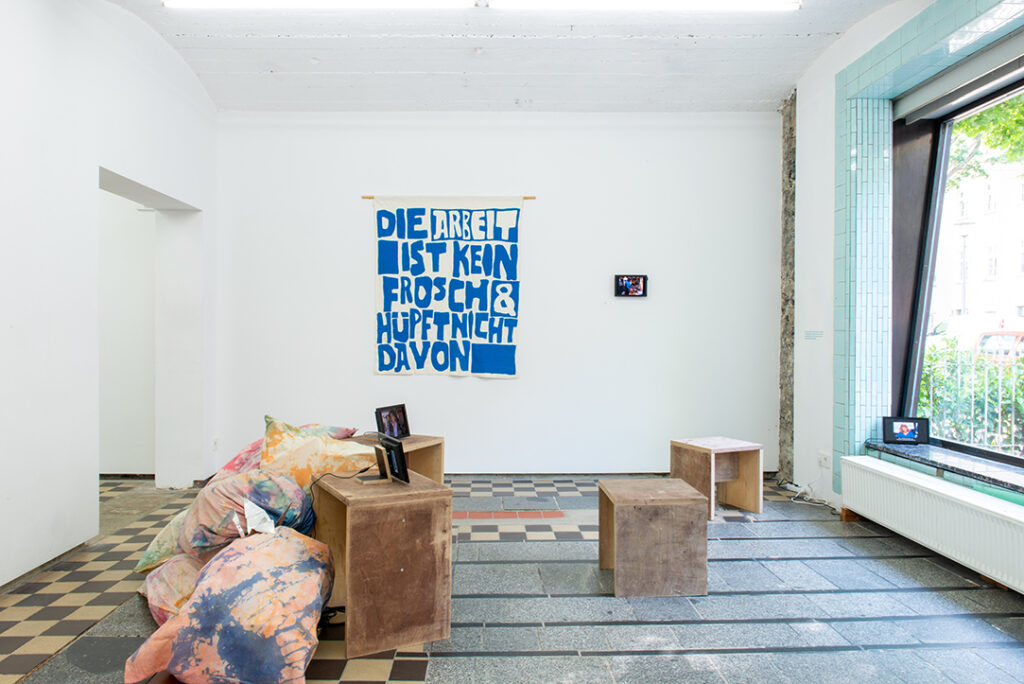
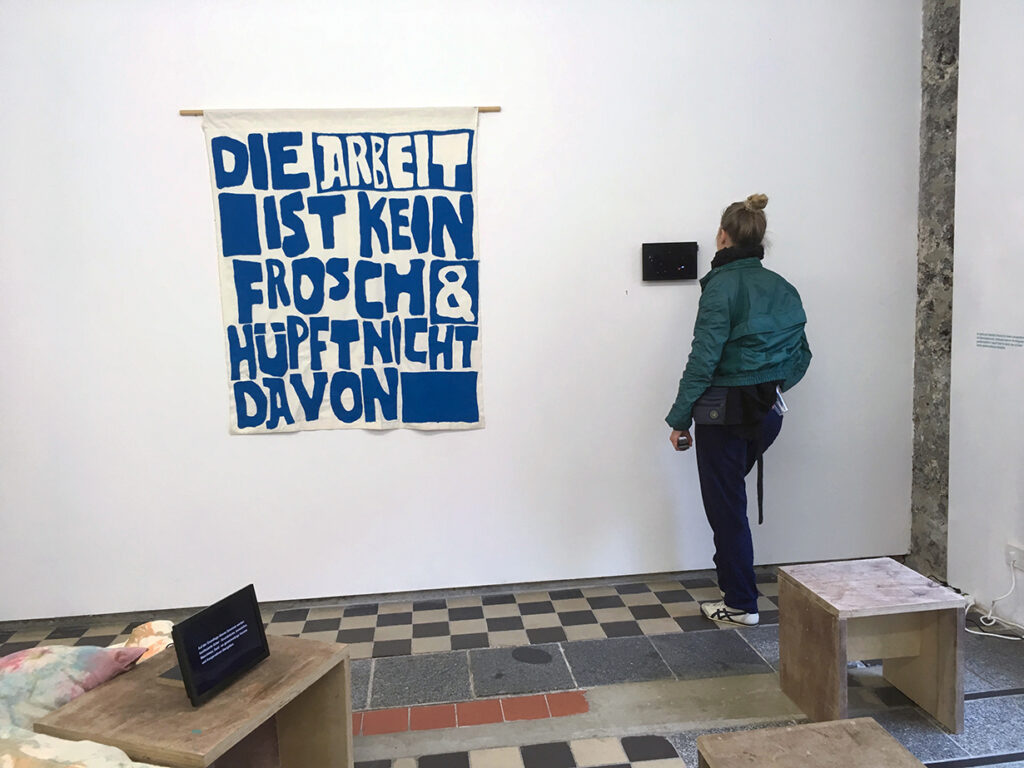
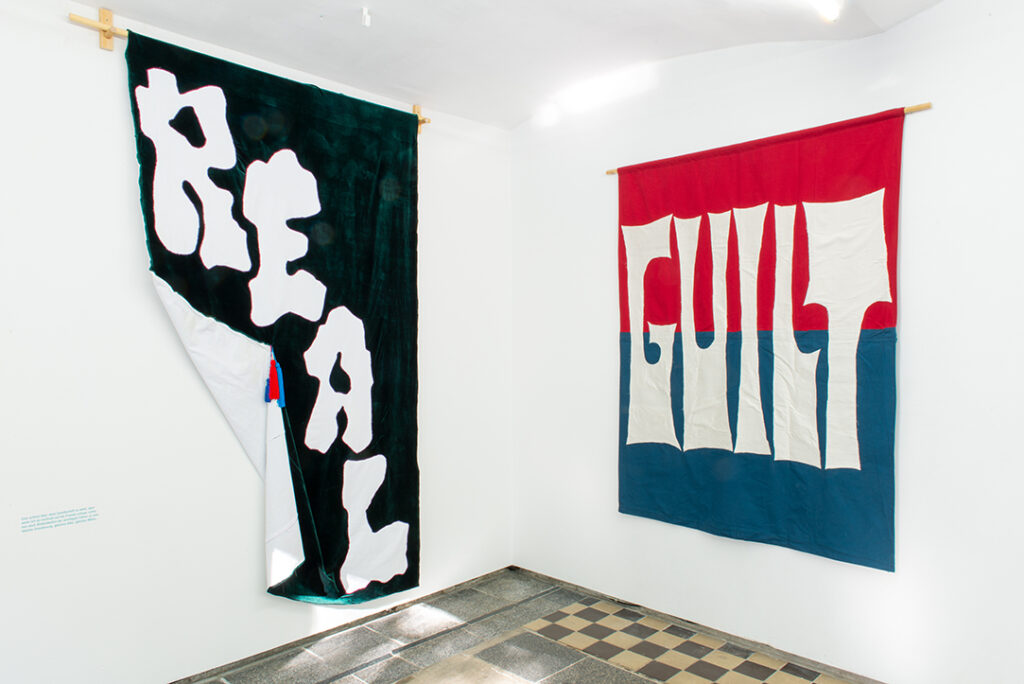
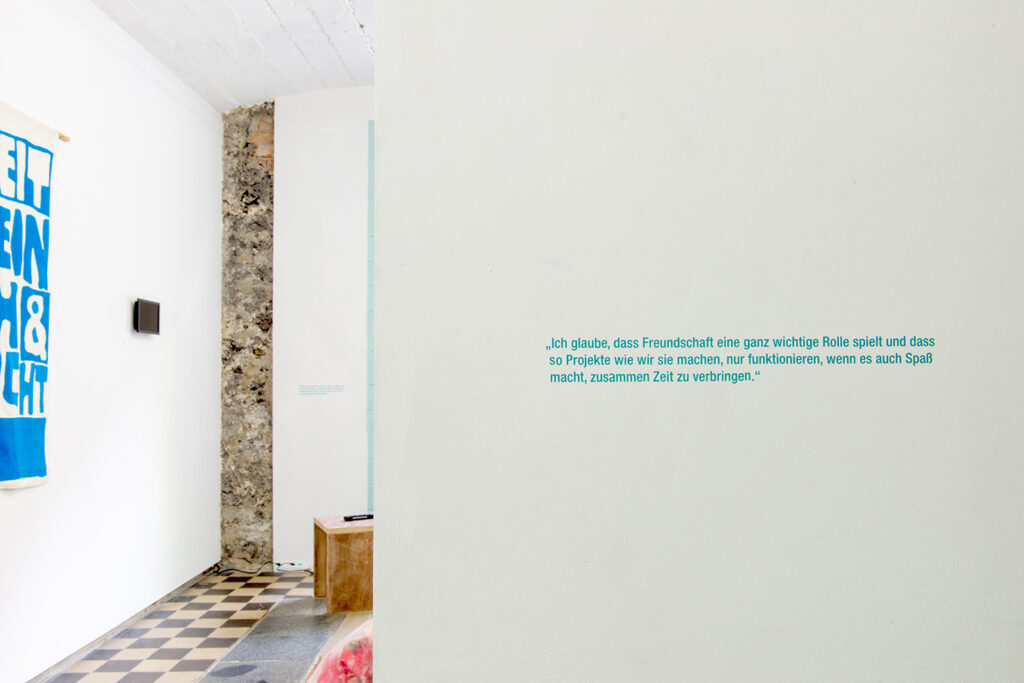
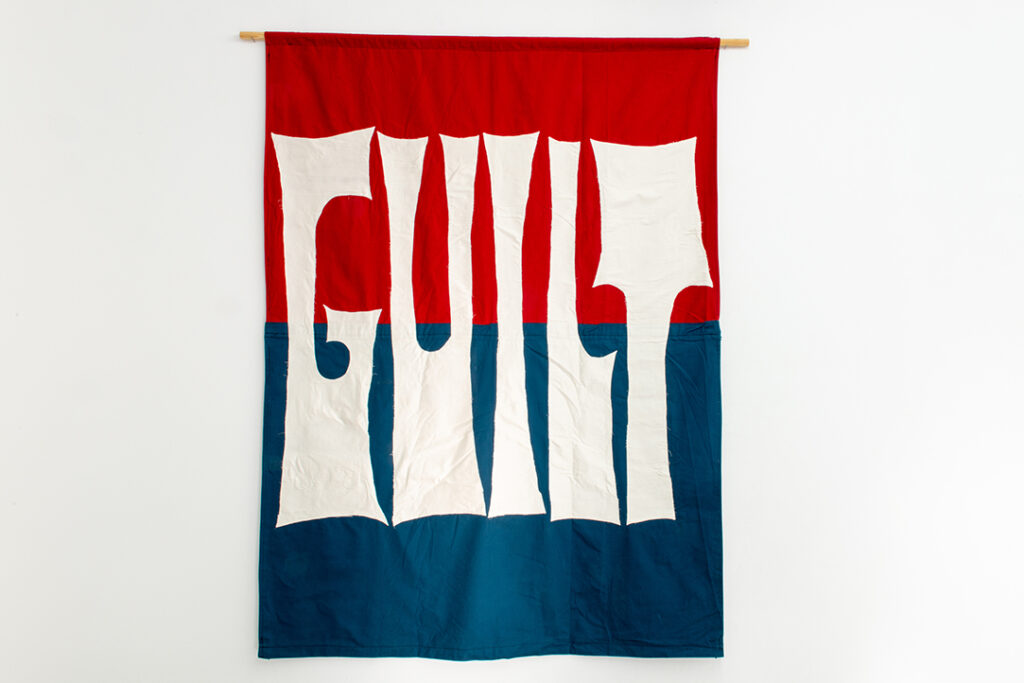
Since 2014 Martin Haufe has been working intensively on the topic of "friendship". Within friendships we larn to act "morally right", at the same fourth dimension capitalist living conditions influence the form of our relationships. In Martin Haufe'south ongoing research, questions about the relationship and potential of criticism and friendship therefore play a fundamental office. His inquiry has resulted in various textile works for the exhibition exemplarische Kämpfe (exemplary struggles).
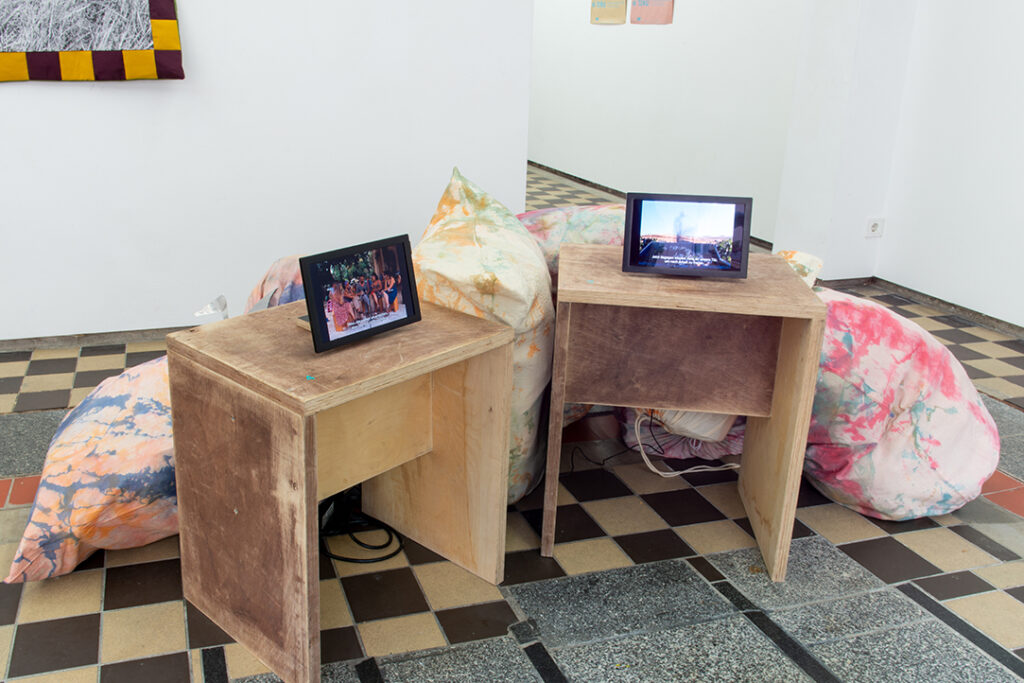
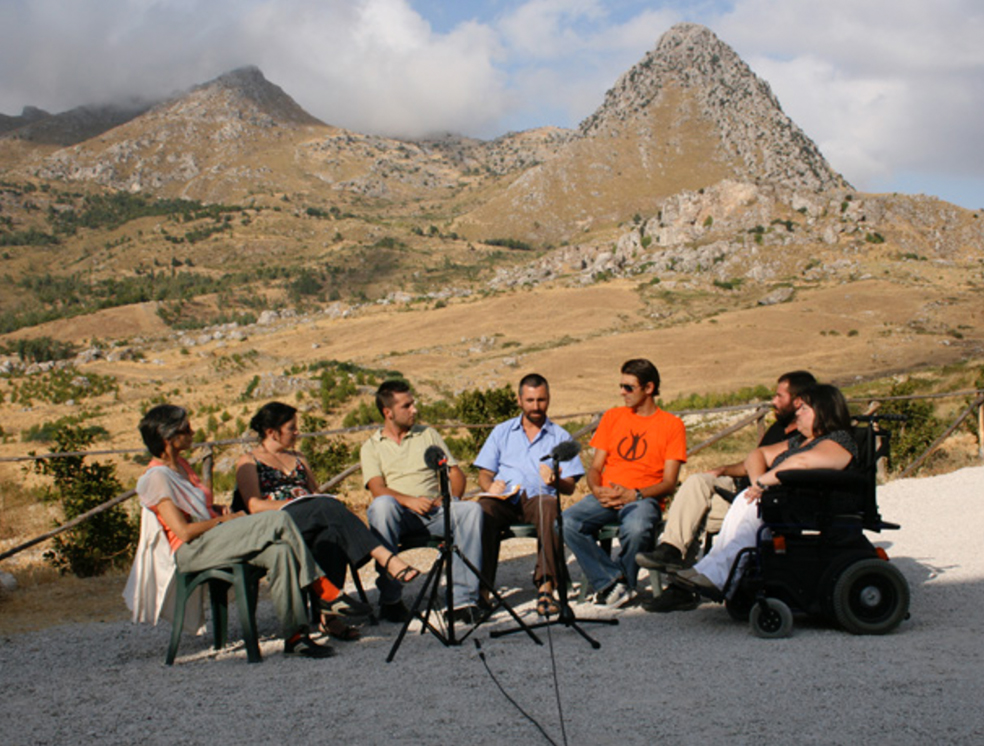
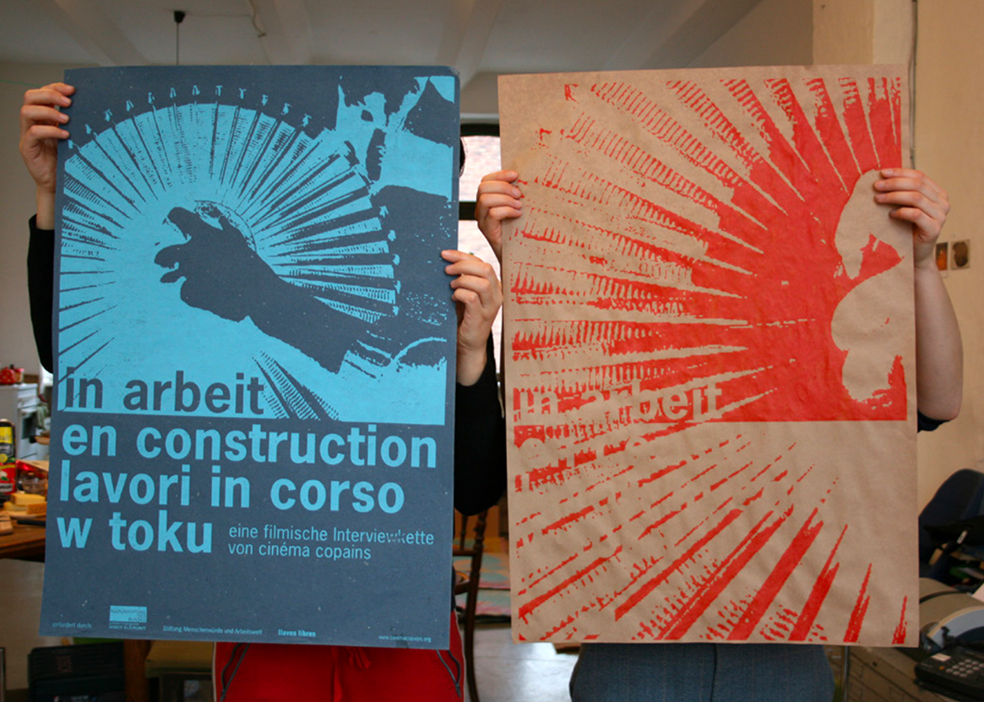
The 6-role interview concatenation "in arbeit" (2008-2018) by Minze Tummescheit and Arne Hector (cinéma copains) is a cinematic investigation of the conditions, possibilities and limits of commonage action. The communicative procedure of enquiry becomes the content of the film. A number of collectives are brought into contact with each other by members of one group travelling together with cinéma copains and holding a chat with the side by side collective together. The event is a concatenation of interviews that paints a picture of cooperative practice in diverse European countries. The exhibition exemplarische Kämpfe (exemplary struggles) shows excerpts from the series, which is 285 minutes long in total.
-
video still cinéma copains -
-
-
-
-
-
video still cinéma copains -
-
Martin Haufe
(*1986 Großröhrsdorf) studied media art at the HGB Leipzig, the Royal Danish Academy of Fine Arts and the MLU Halle (Saale) in the field of psychology. He received a scholarship from the Rosa Luxemburg Foundation, and is currently a principal student of Joachim Bare. Martin Haufe spent several working & research stays in Vietnam and was selected for a KdFS scholarship in 2019. In addition to his practise as a solo artist, he is involved in various commemorative cultural projects and is active as an artistic creator.
cinéma copains
Since 2000 Arne Hector and Minze Tummescheit accept been working as cinéma copains in cooperation with copines and copains from all over the world. They are interested in economical topics, which they always empathise as political and social issues. Their documentary piece of work, which includes lectures, performances, installations and creative documentaries, is based on long-term projects. At the interface between documentary film and art, with a visible political stance, they seek form for content.
Funded past:
Ausstellungsraum für zeitgenössische Kunst und soziale Fragen
santistevanfitain.blogspot.com
Source: https://www.after-the-butcher.de/en/author/redaktion-i/
0 Response to "Art in America Magazine February 2018 Amelie Van Wolffen Artists"
Post a Comment