How to Upload Songs to Ear Sketch
| | |
| Type of site | Online education |
|---|---|
| Available in | English language |
| Created by | Georgia Plant of Applied science |
| URL | https://earsketch.gatech.edu |
| Commercial | No |
| Users | 530.000 |
| Launched | 2011 |
| Content license | Georgia Tech Research Corporation license |
| Written in | JavaScript (customer), Coffee (server) |
EarSketch is a free educational programming environment. Its core purpose is to teach coding in 2 widely used languages, Python and JavaScript, through music composing and remixing. This learning environment was developed first at Georgia Institute of Engineering (from 2011) under Prof. Jason Freeman (Schoolhouse of Music) and Prof. Brian Magerko (School of Literature, Media, and Communication).[1]
EarSketch is web-based, which means users can access it with their spider web-browsers, and with no installation. No business relationship is required to create projects or view existing projects.
EarSketch comprises different elements: a curriculum, a digital audio workstation (or DAW), a code editor and console, and a audio browser. EarSketch's sound library was created by Young Guru, Jay Z'due south sound engineer, and famous audio designer Richard Devine.
Purpose [edit]
EarSketch has 2 main goals: to make figurer science more engaging for students, and to diversify the population of students interested in computer science.
Date in computer science at schoolhouse [edit]
The United states has a shortage of information science students, not just because non all schools are offering CS classes,[ii] simply also because students practise not enroll in such classes. A study published in 2009 states: "The percentage of U.Due south. high school students taking Stem courses has increased over the last xx years across all STEM disciplines except figurer science where it dropped from 25% to 19%".[iii] Considering this, and the fact that all fields of the economy incorporate computing in their operations, EarSketch proposes to motivate students to enroll in CS classes and to pursue CS studies in college pedagogy. EarSketch attempts to reach this goal by adding a musical side to coding. This strategy is a STEAMs arroyo to education that integrates arts into Stalk teaching. A study conducted at Georgia Tech showed statistically pregnant results in this domain: students who study with EarSketch have been shown to make progress both in content knowledge and attitude towards CS (cocky-confidence, motivation, intent to persist, etc.).[four]
Participation in calculating [edit]
Today female and minority students in CS classes are, like in other engineering science fields, underrepresented (with 22% of female students, thirteen% of African American students in US classes in 2015[5]). EarSketch has demonstrated success in tackling this issue,[6] partly considering of the focus on popular genres of music such every bit dubstep, and because EarSketch provides a creative, expressive, and authentic environment (since students compose their own music).
History [edit]
Origin of the name EarSketch [edit]
The proper noun EarSketch originated in a different projection from co-creators Freeman and Magerko focused on collaborative composition and music analysis via drawing. That project never came to fruition, but the idea of collaborative music-making (and the proper noun) remained in a new project focused more on coding and computer science didactics. Though sketching is no longer a focus of EarSketch, the environment does offer cartoon and animation features through P5.
First version: Reaper-based desktop application [edit]
The initial version of EarSketch, released in 2012, was congenital inside of REAPER, a commercial digital audio workstation with extensive support for coding via the ReaScript API for Python and the JavaScript plugin authoring architecture. As the project grew, the Reaper-based version of EarSketch was eventually retired due to its dependence on commercial software, the disability of the team to create an integrated user interface to author code, view musical results in the DAW, find sounds, and challenges installing the software in school computer labs.
Electric current version: web application [edit]
The projection and so evolved to go a website in 2014. This allowed students to outset coding without having to download software. The website uses the web audio API and runs on a private server. New versions are release approximately once per calendar month. EarSketch is not merely a software: the EarSketch team works hand in manus with teachers to build the curriculum, and trains teachers every year in summer professional evolution workshops.
Funding [edit]
EarSketch received funding from the National Scientific discipline Foundation (NSF) (CNS #1138469, DRL #1417835, DUE #1504293, and DRL #1612644), the Scott Hudgens Family Foundation, the Arthur M. Blank Family unit Foundation, and the Google Inc. Fund of Tides Foundation.
Sections [edit]
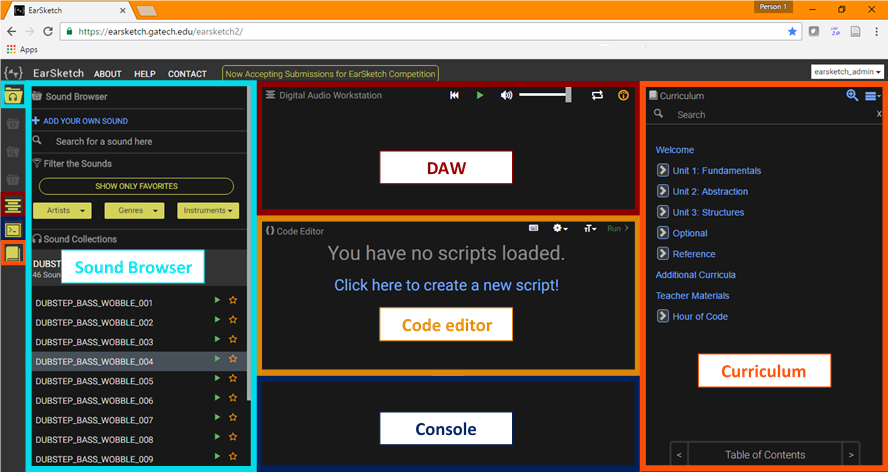
EarSketch is a web application, and when opening a session, users see dissimilar sections: the curriculum, the code editor, the console, the Digital Audio Workstation, and the browser.
The curriculum [edit]
The curriculum is aligned with AP Computer Science Principles merely tin be used in any introductory programming class.
Each chapter has several sections, a summary, a quiz, screencasts, and associated slides. The curriculum is positioned in the right side of the window. It is a textbook for EarSketch that includes capacity about major computing principles, Python and JavaScript, every bit well as an introduction to informatics. The curriculum is divided in the following sections:
- iii units, namely:
- Unit of measurement one is an introduction to EarSketch, calculating and to bones musical concepts (tempo and pitch, effects...),
- Unit 2 focuses on loops, cord operations, musical course and beat,
- Unit iii introduces conditionals, information structures, and randomness,
- Optional more in-depth chapters,
- The API documentation, which describes all the functions that are specific to EarSketch,
- A university-level introduction to information science section,
- Teacher materials, which include lesson plans, examples, slides, and evaluation tools.
- An Hour of code tutorial: Hr of code is a worldwide initiative to engage students in estimator scientific discipline, past providing threescore minute-long ludic introduction tutorials (for instance with Minecraft or frozen components).[7] This detail tutorial is an introduction to computer scientific discipline where students compose their beginning song with EarSketch.
The units are divided into chapters. Each affiliate has several sections, a summary, a quiz, and associated slides. The curriculum contains Python and JavaScript example code that tin exist pasted into the lawmaking editor.
The lawmaking editor and panel [edit]
EarSketch'due south lawmaking editor is located in the window at the eye of the page. When the code is executed, it will create the music in the Digital Sound Workstation. If there is an error in the code, a bulletin explaining the error will appear in the console, located under the code editor.
The digital audio workstation [edit]
A digital audio workstation (DAW) is a tool used by a bulk of music producers which helps dispense sound samples (or audio files), add effects, and accomplish other tasks in the composition process. EarSketch's DAW is located in the superlative heart section, above the code editor. Information technology contains tracks: each line is a runway, and corresponds to an instrument. With lawmaking commands, the user will add sound samples in these tracks, every bit well as effects, such equally volume changes, reverberation, delay, etc. When the code is executed, the DAW will be filled with the sound samples, and the user can play the music they simply coded.
The browser: scripts and sounds [edit]
In social club to compose music, EarSketch coders tin can employ samples. Audio samples are located in the audio browser, in the left window, which allows for sound file search, and personal sound file upload. In the left section, users tin also show the script browser. A script is a code file, and different scripts will create different musics in the DAW.
Main characteristic examples [edit]
Although the code written in the code editor will be either in Python or JavaScript, there are EarSketch-specific functions that allow for the user to accomplish music related tasks. Here are some examples:
- I of the basic functions of EarSketch is fitMedia(), which places a sample audio in the Digital Sound Workstation.
- Another important function is MakeBeat(), that takes as input a cord and a file name. The cord corresponds to times when the file should be played, sustained, or when there should be silence. This is a mutual fashion of creating percussive lines in music programming languages. For instance, in EarSketch, '0' indicates that the file should play, and so '-' means a silence, and '+' means keep playing the sample. So if we use the string "0-000+++", it means play the audio file on the beginning sixteenth note, and so there is a silence, then the file is played three times in a row, and finally, the file keeps playing through the three last sixteenth notes.
- Another example would be setEffect(), which adds furnishings to a track. Effects are common in Digital Audio Workstations as they are an indispensable element of music product. Here are some examples of furnishings:
- Book: this modifies the loudness of a track. Information technology can be used to emphasize a particular track compared to the rest of the instruments. It can too be used to fade in and fade out the music to take a smoother beginning and end.
- Reverb: this makes the samples sound like they were being played in a room that echoes the sounds.
- Delay: this produces an artificial echo.
- Frequency filters: these will modify the sound by either attenuating or highlighting sure frequencies.
References [edit]
- ^ See Brian Magerko, "ADAM, Earsketch, and I," in Humanistic Perspectives in a Technological Earth, ed. Richard Utz and Karen Caput (Atlanta: Georgia Institute of Technology, 2021, pp. 29-31. Electronic access
- ^ "Informatics: Non Just an Elective Anymore". Education Week. Feb 25, 2014.
- ^ http://world wide web.exploringcs.org/resources/cs-statistics, consulted in Nov 2016
- ^ Magerko, B., Freeman, J., McKlin, T., Reilly, M., Livingston, Due east., Mccoid, S., Crews-Dark-brown, A. (2016), ACM Transactions on Calculating Pedagogy (TOCE), Vol xvi, Issue 4
- ^ www.whitehouse.gov consulted in November 2016
- ^ Freeman, J., Magerko, B., Edwards, D., Moore, R., McKlin, T., & Xambó, A. (2015, August). EarSketch: A STEAM approach to broadening participation in information science principles. In Enquiry in Equity and Sustained Participation in Engineering, Calculating, and Engineering science (RESPECT), 2015 (pp. one-2). IEEE.
- ^ https://code.org/learn, consulted in November 2016
santistevanfitain.blogspot.com
Source: https://en.wikipedia.org/wiki/EarSketch
0 Response to "How to Upload Songs to Ear Sketch"
Post a Comment